No install
Nobody is installing software for one evening of your wedding
Wedding photo sharing without an app is not a lesser version of the real thing. A browser page is already on every phone in the room, and an install is a request no guest owes you.
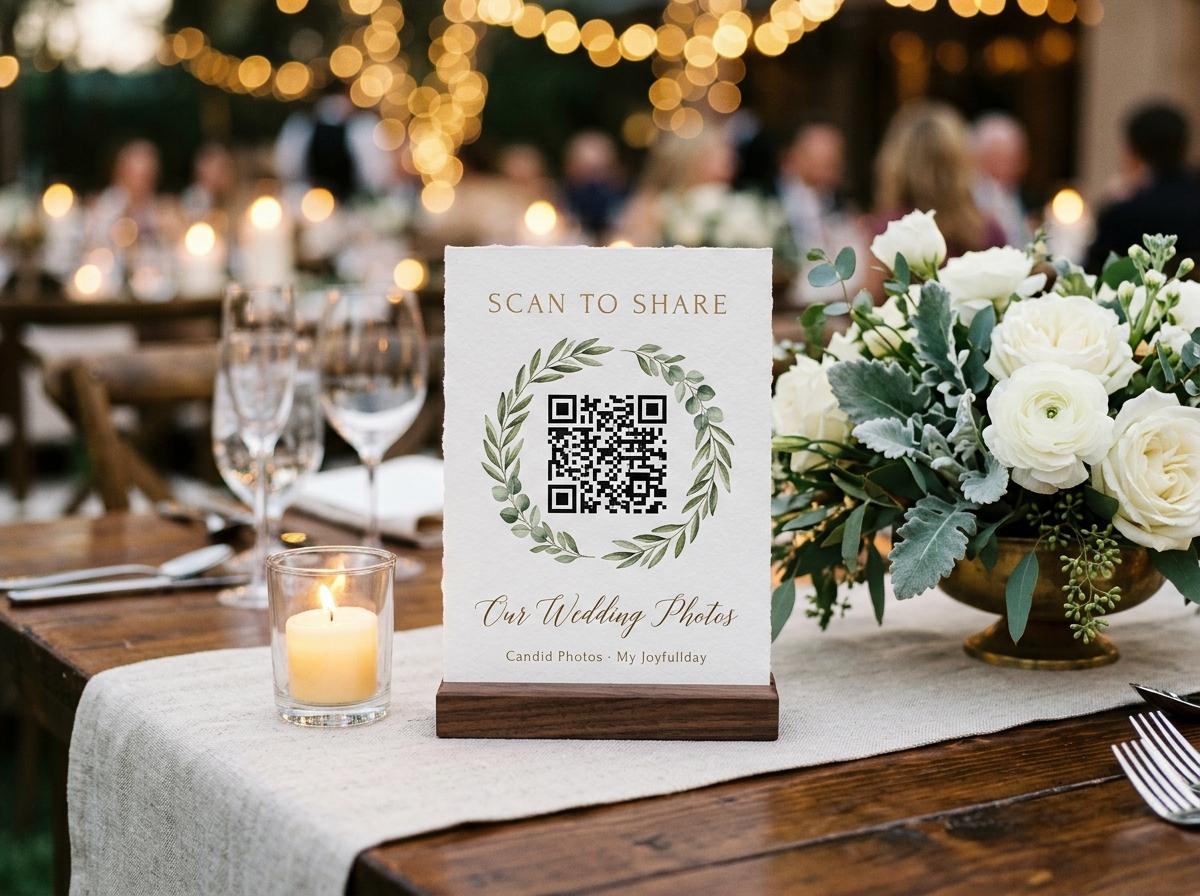
There are good photo applications on the market. Some of them are genuinely nice, well-made, and completely useless at your wedding, because they all ask the same thing of a guest at table nine: to acquire software for someone else's one evening. Every host who has watched a reception knows the answer to that ask before it is made, and the knowing is the whole argument of this page.
The arithmetic of asking a guest to install something
An install is not one request. It is six, made at the worst possible time, on the worst possible connection, for a favour.
- The store detour
- Search, find the right one among three with similar names, wait. On a venue network built for booking forms, a ninety-megabyte download competes with a hundred and forty phones.
- The space excuse
- Somebody always needs to delete photographs to fit an application they will use once. Ask a guest to empty their camera roll at your wedding and you have cancelled the very uploads you came for.
- The registration wall
- An email, a password, a verification link, an app update. Each step is a guest who stops, and each stop is permanent; nobody resumes at eleven o'clock.
- The abandoned icon
- Even the guest who gets through all of it closes the application afterwards, and it rots on the sixth screen of the phone as a small monument to your evening.
- The one that matters
- The photographs are already in the phone. Everything above is a detour away from the file, paid for by a person who came to watch you get married.
What is already on the phone instead
The browser. Every guest opened it today, it holds their camera roll behind one button, and it reads the code on your table card without being taught anything new. The guest journey is therefore the shortest one the technology allows, and the honest claim is small but real: wedding photo sharing without an app means the ask costs fewer taps than the hesitation it replaces.
Point the camera at the card
The camera application guests already use reads the code; no separate scanner, no third-party tool, and the address is printed beside it as text for anyone whose focus gives up at nine p.m.
Choose files
The picker opens on the phone's own recents, and photographs and clips go into a single submission without the guest deciding which kind of file they mean.
Type a name, once
One field, the only personal thing asked. The page remembers the sender for twelve hours, so the second batch that evening asks nothing at all.
Send and look back up
A receipt says it arrived. Nothing stays open, nothing needs confirming by email, and there is no account to forget about later.
The case for an app, stated honestly
A page like this earns its credibility by making the other side's argument properly, so here it is. Applications are the right tool when the job is continuous: a photographer who lives inside a delivery pipeline, a family maintaining a shared library for a decade, a planner running twenty events at once. In each case somebody opens the tool every week, learns it, and is paid or pleased to do so.
An app is right when
- The same person uses the tool again every week.
- The job needs an account, history and settings someone will return to.
- Storage is the product itself, and the user signed up for it deliberately.
- The person installing it is the person who benefits first.
A browser page is right when
- The contributor has one evening and forty seconds.
- A hundred and fifty strangers must reach the same page with zero training.
- The venue network is weak, so nothing may need downloading first.
- The couple owns the collection and the guests owe the couple nothing, least of all a login.
A wedding is always the right-hand column for the people filling it. The hosting side is the one place a login exists, and it lives on an ordinary website, not in anybody's pocket.
The measure of a collection tool is not what it can do. It is what the eighteenth guest can do with it, at table nine, without help.
The code is the launcher that needs no launcher
What a QR code replaced, two decades ago, was exactly the typing of long addresses on small keyboards. At a wedding it does that job again, cleanly: every collection gets a short address and a matching code, four table stands print on one A4 sheet from the dashboard on an ordinary printer, and the stand does the asking for you in front of twelve seated guests for two hours.
- Put the typed address beside every code: the same page, reached by the guest whose camera cannot focus and the guest who distrusts squares.
- Send the link as text to the group chat the morning of the wedding, for the relatives who are contributing from their own kitchens.
- Print stands for the tables, the bar and the cloakroom, because the guests who never sat down are the ones holding the dance floor.
- Say thirty seconds about it in the welcome, phrased so a guest could repeat it: the code on your table is how your photographs reach us.
- Test one scan on the venue wifi while there is still an evening to change anything.
No phone needs to be told what to do with the code. Reading it is already part of the camera that took the photographs.
What the no-install design also buys you
The files arrive as they left the camera
There is no gallery application re-encoding anything on the way in. The photograph a guest chose is stored exactly as the phone had it; only the small grid tile is drawn, and that is sketched on the guest's own device.
The absent relatives use the same door
Nobody in another country is worse off for not being in the room: the address reaches them, and a photograph or a written wish from their kitchen lands in the collection with their name on it.
Nothing needs to go right before the first upload
No store region, no spare gigabytes, no password reminder, no update prompt in the middle of your vows. The failure modes of an install are quietly removed from the evening, one after another.
The old ones and the young ones do the same thing
A guest who can use a camera app can use the page, because that is all it asks them to use. This is the only interface in the wedding industry with no learning curve at either end of the family.
What it costs the connection when the room goes full
Honesty about the weak venue network belongs on this page specifically, because it is the argument the app crowd does not want made. A hundred and forty phones on one access point is a load nobody designed for, and an application makes that worse before it makes anything better: the whole room pulls a large file down before a single photograph moves. A page that is already there pulls nothing down; it asks only for the upload, it runs its grid on locally-drawn tiles, and when a transfer stalls the photographs simply stay in the guest's camera roll to go up from a hotel corridor the next morning.
A stalled upload is delayed, not destroyed
Nothing is lost when a marquee network gives out: the files remain on the phone, the address remains in messages and history, and the collection remains open. Design the announcement so that the ask survives being postponed to Sunday, because on a bad night it will be.
Guest uploads from the browser, no loginWhere the late uploads really come from
A meaningful share of any wedding collection arrives after the room has broken up: from hotel corridors, train seats and one Sunday morning when somebody finally looked at what they shot. That tail only exists because the address stayed open and the page demanded nothing, and any plan of the evening that assumes all uploads happen between the soup and the last dance is a plan against a fraction of the set.
The host side: an account on a website, not in a pocket
Somebody has to own the collection, and that part of the product does involve signing in, in the ordinary way, on an ordinary website. You manage the settings, the review queue and the downloads from a browser tab, on a laptop, in the quiet week after the event. The line worth holding: your account exists so that the guests never need one. They are asked for a name and a file, once, and the difference between those two experiences is precisely the thing that fills the collection.
Five lines that do the asking without asking anyone
Hosts tend to over-explain the technology and under-explain the favour. The wording below keeps the sentence about the photographs, mentions the absence of setup exactly once, and gives the guest a specific, finishable job. Say one of these out loud, print one, send the others as text; the phrasing matters less than the repetition.
- On the card, beside the code: a plain web page, no app and no login; six frames and thirty seconds, and we keep everything you send us.
- In the welcome speech: whatever you photograph tonight can be on the screen behind the band, using the square on your table.
- On the morning, to the group chat: if your camera roll is already full of today, this link is the quickest way to pass some of it on.
- Privately, to the cousin who shot on a real camera: everything you took, not your favourites; we would rather choose from hundreds than wonder what you left out.
- To the relatives who could not travel: the page stays open through the week, and there is a guestbook on it if you want to leave a word.
Sizing the plan a browser full of guests will fill
The no-install design decides how contributions arrive; the plan decides how many of them fit and how long the page stays up. Prices are one-off in US dollars per event, and the ceilings are known in advance rather than discovered mid-dance.
- Preview · free
- 20 photographs, 10 contributing guests, 7 days online, no video and no downloads. The honest use at a wedding is a rehearsal at the engagement dinner.
- Gather · $19
- 200 photographs, 30 clips, unlimited contributors, written guestbook, standard downloads, six months online. The shape of an elopement or a courthouse day.
- Celebrate · $39
- 750 photographs, 100 clips, video guestbook and live slideshow included, original-quality downloads, twelve months online. Where a normal wedding room of photographing guests should start.
- Keepsake · $69
- 2,000 photographs, 300 clips, premium themes, two extra managers, 24 months online. For the large or multi-day wedding whose count will be genuinely high.
- Add-ons
- Extra uploads from $5 to $15, longer retention for $9 or $15 more, starting when the included period ends. Contributor count is never the ceiling on a paid plan; file count is.
App questions, answered as asked
Do wedding guests need to download an app to send photographs?
No, on every plan including the free one. The code or the link opens a browser page, the guest picks files, types a name and sends; nothing is installed and nobody registers.
Does it matter whether a guest has an iPhone or an Android?
It does not, because the guest never leaves the browser that came with the phone. The only difference is which camera application reads the code, and both of them do it by default.
What about guests who will not scan anything?
They were always the typed-address people. The same short address is printed beside every code and sent as text in the group message, so the sceptics have a door that asks nothing of their trust.
Do the hosts themselves need an app to manage the collection?
No. The dashboard is an ordinary website: settings, review, slideshow and downloads all happen in a browser tab, which is the same device the couple is planning the seating plan on anyway.
Is image quality sacrificed by avoiding an application?
The opposite. The file a guest chose is stored as it arrived, and messaging-style squeezing never happens on the way in. Downloads give standard files on Gather and originals on Celebrate and Keepsake.
Will a weak venue network defeat a browser page too?
It slows uploads for everyone, but the recovery is different. Nothing needs downloading first, a stalled file stays safely in the guest's camera roll, and the collection stays open for the whole length of the plan while the hotel corridor finishes the job.
Why does nobody offer this without an install?
Because an application looks like a product and a browser page looks like a website, and buyers are trained to want the thing with an icon. Guests, who are the only market that matters on the night, want the thing with fewer taps.
Run the whole evening on pages your guests already know how to open
Open a collection, print four sheets of stands, and put nothing between a guest's camera roll and your archive. The free plan runs a real event for seven days, which is the cheapest way to watch an install-free collection fill.
Wedding photo sharing
Put one link on the tables and let everyone contribute.
Create a collection, print the table stands, and the photographs your guests took are waiting for you the morning after. Guests never install anything and never make an account.