The gallery page
What your wedding photo gallery online shows, and to whom
A wedding photo gallery online is the one surface every guest lands on and almost nobody describes in advance. Here is the page itself: what stands at the top, what the grid is made of, and the switch that turns looking off while the photographs keep arriving.
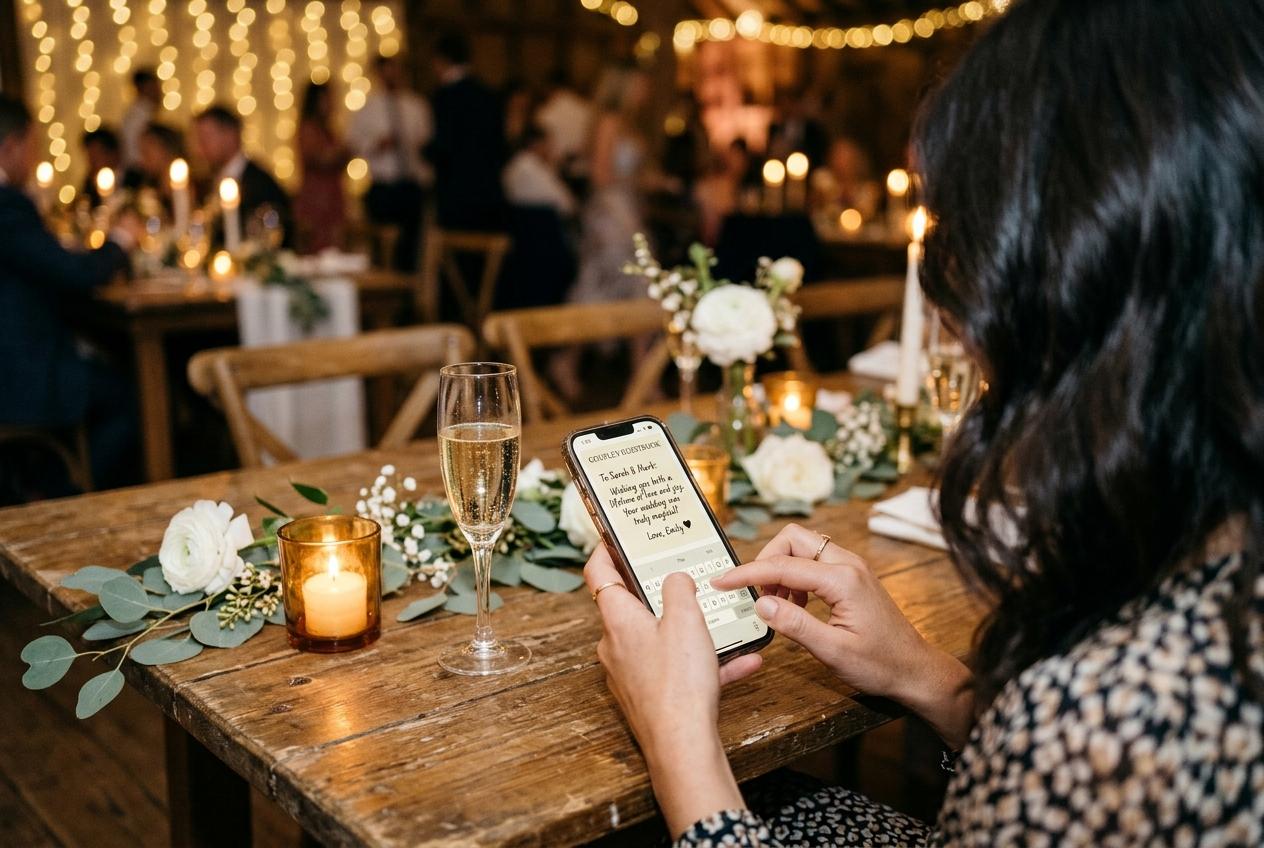
A guest taps a short address, or points a camera at the card on the table, and a page opens in the browser they already use. In the next two seconds they decide three things: whether this is really your wedding, whether uploading is worth the effort, and whether they are allowed to look. A wedding photo gallery online is judged in exactly those two seconds, which makes it worth knowing what the page actually contains before you send a hundred and fifty people to it.
The page itself, from the top to the send button
Six parts, in order, and every one of them answers a question the guest is asking without saying it aloud.
- The names and the date
- Your occasion carries your names and your wedding date at the top of the page. This is the difference between a page a guest trusts and a page a guest closes, and it is the reason the address should never be handed out as a bare code on a napkin.
- The welcome line
- A sentence or two in your own words, written before the day. Short works better than warm here; the line that reads like a text from a friend gets more uploads than the one that reads like an invitation.
- The grid
- Everything accepted so far, in the order it arrived, drawn from small preview tiles. The tile is a sketch produced on the uploader's own phone; the real file sat untouched in storage the whole time.
- The picker
- One button opens the guest's photo album, and photographs and clips go into a single submission. There is no separate lane for video and no reason to decide what kind of file you are holding.
- One name field
- Typed once, remembered for twelve hours. It is the only personal thing the page asks, and the only one worth asking: it tells you whose camera a frame came from.
- The receipt
- A plain confirmation that the submission arrived, so nobody has to hang around wondering whether the venue's connection carried it. Then the page gets out of the way.
Two ways to run it: looking allowed, or sending only
The gallery switch decides which kind of page your guests meet. On, the grid is browsable by anyone holding the address, and the collection reads like a running record of the day. Off, the page is upload-only: sending works exactly as before, browsing does not exist, and the couple remains the only audience. Nothing else about the page changes between the two states, which is why so many hosts flip it mid-evening without thinking twice.
The open grid invites
- A guest who sees their own frame among the others tells the whole table the link is real.
- Late senders can see the set is filling, which nudges the hesitants into action.
- Relatives far away get a live view of the day they are missing.
- The room can compare notes about who photographed what.
Upload-only protects
- Nobody photographs somebody else's bad angle for the room to commentary on.
- The couple keeps the surprise of seeing the whole set at once, later.
- Submissions still arrive, still land with names, still reach you.
- A room full of opinions never gets to form one about other people's uploads.
Plenty of hosts run it closed through the evening and open it on the Sunday, when the set is already full and curated and the room is at home.
What a guest cannot see, and what that is for
There is a middle layer between the files sent and the grid displayed, and couples are usually surprised to learn it exists at all. When approval is switched on, every submission waits quietly in the collection, visible to the hosts, invisible on the guest page and off the room screen. Blur, somebody's elbow, a shot of the floor: the pile stays yours until you work through it, and a refusal leaves no trace. It takes two minutes between courses, and on a room of relatives it is the difference between a wedding album and a wedding conversation.
Waiting submissions are not lost submissions
A collection that looks empty on the guest page may hold sixty photographs behind the approval switch. If the room is contributing but the grid is not moving, the first place to look is the host's own view, not the wifi.
How to run the review passWho can reach the address, and who never finds it
The gallery is private in the specific, unglamorous sense that matters: it is not published anywhere. The address is not carried by any directory or sitemap, guest pages are kept out of search indexes, and the only ways in are the ones you chose: printed stands, a message, a typed link. Anyone who has the address can open it, so the real control is distribution, which you already decided when you put the card on the tables.
- Write the welcome line so a guest who does not know the couple recognises the wedding as yours.
- Decide the browsing state before the first upload, not while the room is watching.
- Set approval, if you want it, while you are calm rather than between the soup and the fish.
- Put the address on the card as text as well as code, for the guest who types and the guest who distrusts.
- Keep the link inside the wedding party and the printed tables, and decide deliberately before it goes wider.
Not listed, not indexed, not advertised. A wedding gallery is private the way a house party is private: anybody with the address can come, and nobody without it knows there is anything to come to.
The grid tile and the original file are two different things
This is where a gallery claim about quality either means something or does not. The tile is a sketch produced on the uploading phone at the moment of sending, so the grid stays light on a venue connection that was built for booking forms. The file behind it is exactly what the guest chose from their camera roll, kept whole. What changes between plans is the way the collection comes down: no downloads on Preview, standard downloads on Gather, the original files on Celebrate and Keepsake, and individual frames available whenever one person wants one picture.

Chosen on the guest's phone
From the recents the camera app already sorted into today, with no squeeze applied on the way out.
Sketched locally
The browser on that same phone draws the preview tile, which is why the grid loads quickly even when the upload is a very heavy portrait.
Filed with a name
Against your wedding, against the guest, in the order the evening produced it.
Shown where you allowed
The grid if browsing is on, nothing if it is off, and nothing at all until accepted if approval is switched on.
Downloaded whole, or left out
The archive carries every file that stayed in the collection and excludes the submissions you refused.
A phone at the table, a laptop in June
The same address behaves like two different products depending on who opens it and when, and both shapes matter. It is worth designing the evening around the phone and the afterlife around the laptop.
At the table
Six inches of screen, one thumb, forty seconds. The grid is narrow, the picker is the phone's own, and the name field is the only keyboard moment. Everything about the page assumes a guest who is supposed to be watching the couple, not filing photographs.
From home, later
The page is an ordinary web page, so the guest with four hundred frames contributes from a kitchen table on a real keyboard at a speed that suits them. A gallery that works only on a phone loses the late, chosen, best half of the set.
On the big screen in the corner
Accepted photographs can also play on a room television or projector through a separate, token-gated address, in one of twelve looks that set pacing and typography for a wall rather than a screen you hold. It is the same collection, shown with manners.
The look of the thing
Appearance steps up across the plans: a plain gallery on Preview, standard on Gather, advanced options on Celebrate and premium themes on Keepsake. The layout is the smallest part of why guests upload, but it is the part your photographs will wear for years.
From the far side of the world
One quiet use of an online gallery gets overlooked because it is not really about the wedding day at all. The same address reaches the grandmother on another continent, the friend on a night shift, the cousin who could not get the visa. They open the page whenever their morning starts, watch the room fill up photograph by photograph, and can add a written wish or a photograph of themselves at home to the same collection, with their name on it like everybody else's. A gallery that is open for browsing turns absent relatives from people who get told about the wedding into people who were, in some small way, at it.
Why the page still moves on a connection that cannot cope
Barns, cellars, marquees and restaurant back rooms are all excellent venues with one shared defect: the wireless was installed for booking forms and has never, in its life, carried two hundred phone cameras at once. A gallery earns its keep by being built for that reality rather than pretending it does not exist.
- The grid runs on preview tiles sketched on the uploader's own phone, so a browsing guest is not pulling every full-size file just to scroll.
- Nothing in the whole visit needs an install, which spares the venue's access point the one download a hundred and fifty phones would have attempted at once.
- A stalled upload loses nothing: the frames stay in the guest's camera roll, the address stays in their messages, and the collection is still open at midnight.
- Video is the first thing to be postponed rather than lost, so the clip of the toast usually arrives from a hotel corridor the next morning, and the gallery simply has one more tile on it.
An empty gallery has two entirely different causes
If the grid is not moving, check whether submissions are waiting behind approval before you blame the connection, and check whether browsing is switched off before you conclude the room ignored you. Reaching for the wifi first sends hosts chasing a problem that was a setting.
Guest pages and the twelve-hour nameA gallery is not a cabinet. It is a page one hundred and fifty strangers will open for forty seconds each, on a connection nobody chose, and it has to work anyway.
When the gallery is actually opened, and by whom
The evening
The contributors, not the audience
Guests visit to send, stay twenty seconds, and leave. The browsing that happens on the night is accidental and wonderful: a table spotting one of its own frames and the person beside them reaching for their phone.
The following week
The real peak
Thank-you messages, the chosen frames for the announcement, the hunt for one photograph of the grandfather nobody could place. The address is still in messages and history, and the gallery is doing its best work while the day is still recent.
Months later
The long tail
Every plan states how long the gallery stays online from the event date, warning mail comes before the end, and the archive the hosts took is what survives. A gallery with an honest closing date is the one that gets downloaded in time.
Gallery questions, answered in two sentences
Is a wedding photo gallery online public?
No. The address is listed nowhere and the pages are kept out of search indexes, so the gallery reaches the people you handed the address to and nobody else.
Can I let guests upload but stop them browsing?
Yes. Switch the public gallery off and the page becomes upload-only: contributions keep arriving exactly as before, and the grid is visible only to the hosts.
Do my guests need an account to open the gallery?
Neither an account nor an app, on every plan including the free one. The page opens in the browser already on the phone, asks a name once, and remembers the sender for twelve hours.
Why does the grid look fuzzy next to the download?
Because they are different objects. The tile is a sketch drawn on the uploader's phone for speed, and the download hands back the complete file the guest chose.
Can the gallery play on the room's television?
Yes, through a separate slideshow address that is gated by its own token. With approval on it plays accepted photographs only, which is what makes it safe to leave running in a room you cannot supervise.
Should the address go in the wedding invitation?
Some hosts do, and it works: the page exists from the moment you open it, and guests who like to prepare are happy to find the collection early. The only cost is that the set may start filling before you have settled the browsing and approval decisions.
What happens to the gallery when the plan's period ends?
It comes down, following warning mail to the host. Plan lengths run from seven days free to twenty-four months, and extensions can be added to a collection that is still open.
Open the gallery and then read it from a guest's seat
The free plan runs a real collection for seven days: send the address to five friends, watch what they do with it, and fix the two seconds that matter before your wedding fills the page.
Wedding photo sharing
Put one link on the tables and let everyone contribute.
Create a collection, print the table stands, and the photographs your guests took are waiting for you the morning after. Guests never install anything and never make an account.