Door and room
An event photo gallery with a QR code, and the room it opens on to
An event photo gallery with a QR code is not two things you buy. It is one object with a printed side and a stored side, and the value is entirely in what happens after the address is reached.
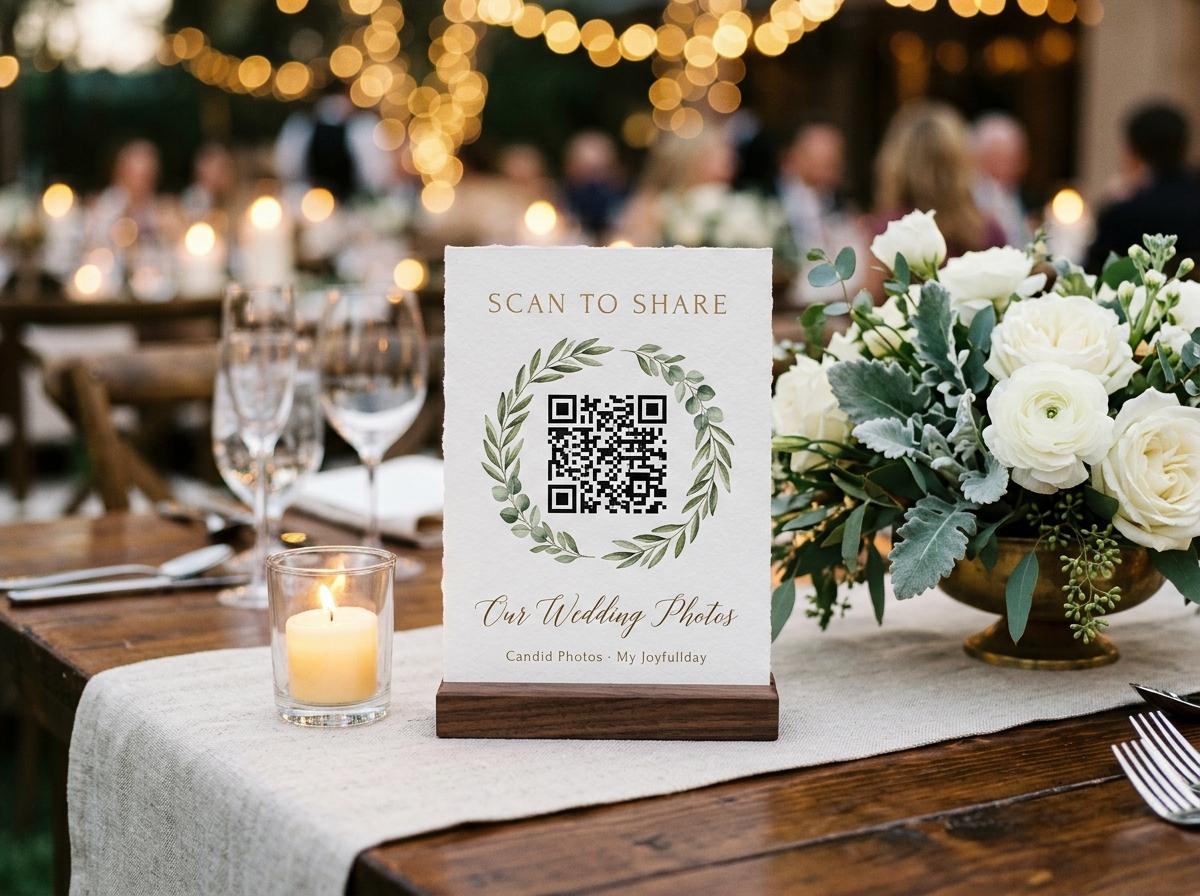
People search for the code because the code is the part they can see. It is on the table, it is on the welcome board, it is the thing a guest photographs with their phone in a room where nobody is reading a URL aloud. But a code is a door cut out of paper. On its own it holds nothing, keeps nothing, and closes nothing. The reason it is worth printing is the room behind it: a collection with a name on it, filling up all evening with photographs taken by the people standing in front of you.
The two halves of one product
Separate them and both fail, which is why they are not sold or built separately.
A gallery with no printed door
It exists, and nobody in the room can reach it. A web address written in an invitation is read by the four people who read invitations, and forgotten by everybody else within a day. Without something physical in the room, the collection waits for a request nobody remembers how to make.
A code with nothing behind it
This is the failure every host has met: a card printed by somebody else, an address that opens a dead page or an empty shell with no name on it. A guest who arrives somewhere that does not look like their friend's wedding leaves within five seconds, and they do not come back to check.
The pair, working together
The door does one job, which is to move a person from a table to a page without a single typed character. The room does the other jobs: telling them whose collection it is, taking their files, remembering their name, keeping the set until the host downloads it.
Why the pairing has to be automatic
Every collection gets its short address and its matching code at the same moment, so there is no step where a host has to connect two products together. Nothing is printed before a gallery exists, and no gallery sits unreachably without a code to hand out.
What a code carries, and what it leaves to the page
- What is in the printed square
- One address, encoded. Nothing else, and that is deliberate: no app to fetch, no sender identity, no temporary token that expires between the welcome board and the last dance.
- What is on the page it reaches
- The name of the occasion, the hosts, the date, and the welcome line you wrote. Then a picker for photographs and clips, one field for a name, and whatever the room has produced so far if you have left browsing on.
- What the code does not decide
- Whether a guest may browse, whether a submission waits for you, whether the guestbook is open, how long the collection stays online. Those are settings on the room, so moving the card to another table changes nothing about who can see what.
- What happens if the square is ruined
- A wet table card or a bent stand is not a lost collection. The same address is a plain string, so it can be typed, pasted into a message, or reprinted in a minute from the dashboard. Nothing in the room depends on one piece of paper surviving the evening.
The code is the only part of this a guest ever touches twice. Everything worth keeping is on the other side of it.
Three surfaces behind one address
It is worth being clear about this, because the phrase photo gallery hides the fact that the same collection is shown three different ways to three different people.
The guest page, reached from the code
Deliberately short. One line to read, a picker, a name, a send button, and the option to leave a message if the guestbook is open. It is built for a thumb, standing up, in half a minute.
Your own view of the collection
The same photographs with the machinery attached: what arrived and from whom, how much of the allowance is used, the settings, the stands to reprint, the reminder mail, the slideshow link and the download.
The room screen
A separate address that plays the collection full-screen on a television or projector, with type and pacing meant to be read from across a room. It is its own link so that a venue can be handed one thing rather than everything.
A guest who arrives at the door never sees the second surface and rarely needs to know the third exists. But the reason the pair works at all is that the same files move through all three: the photograph somebody sends from table nine is in your collection, in the grid the room is browsing, and on the screen behind the band, usually within a couple of minutes of each other.
What the room holds by the end of the night
- Every photograph a guest chose to send, stored as the file that left their phone rather than a squeezed copy of it.
- The clips, from the same picker and the same submission, on any plan that takes video.
- A name against each one, so a frame you cannot place has a person you can ask.
- Written messages, and recorded video messages where the guestbook is open.
- The slideshow rotation the room watched, built out of the same set of files.
- One archive at the end, which is the whole collection in a single download.
None of that is a feature of the printed square. It is what a gallery is for. A code is worth ordering from a printer because the thing it opens keeps the evening; the card itself is disposable, and the photographs are not.
The door, physically
- Four table stands come on one A4 sheet, cut and folded, from an ordinary printer and ordinary paper.
- The address is printed as text beside the square, for the guest who would rather type it and the one whose camera will not focus on small print.
- A stand earns its keep on a table where people sit for an hour, not on a board by the door that is walked past twice.
- The name of the occasion belongs on the card. A code that leads to a brand page reads as advertising; a code that leads to two names and a date reads as an invitation.
- Reprinting is free and instant, so a card lost to a rainstorm or a small child costs a sheet of paper rather than the collection.
The printed side is a distribution problem, not a design problem. It has to be in front of a person who already has their phone out.
The gallery a code opens, compared to the alternatives
A code that points somewhere else
- To a store page, which is the same install request wearing a paper disguise.
- To a social post, where the photographs belong to a platform and a hashtag rather than to you.
- To a cloud folder, which wants a sign-in before it will take a file.
- To a form tool, where the pictures arrive as attachments in somebody's inbox and are gone in a week.
- To nothing, because the card was printed before the collection was made and the address has no room behind it.
A code that opens the collection
- One address, generated with the gallery rather than bolted on afterwards.
- A page that names the occasion and the hosts before it asks for anything.
- Photographs and clips in a single submission, with a name attached.
- A collection the host can browse, moderate if they choose, and download entire.
- A closing date stated in advance, so the room knows how long the door stays open.
A printed code is only as good as the thing it reaches. The square of dots is the cheap part.
Who reaches the door, and when
Before the day
The address travels as text
The same link goes in an invitation, a group message, or a website page, and contributions start arriving before anybody is in the room. A photograph of the outfit, a message from the relative who cannot come, the venue as it looked in the morning.
On the night
The stands do the asking
This is the only window in which a guest has the photographs, the phone, and the attention in the same place. Guests arrive at the page from the card on their table and leave it as soon as the send button is pressed.
The days after
The door is still standing
The address has not changed, so the Sunday clear-out still reaches the same collection. This is when the best frames arrive, chosen properly rather than grabbed between courses.
The closing date
The door comes down
Every plan states how long a collection stays online from its event date, and warning mail arrives before it does. After that the printed card opens nothing, which is as it should be: the photographs are in your archive by then.
Do not leave the printed side until the last morning
Stands cut and folded the week before, and set out before the first guest arrives, collect the photographs taken on the way in and during the drinks. A card produced while the room is already seated loses the hour in which people are most willing to send something.
Setup in the help pages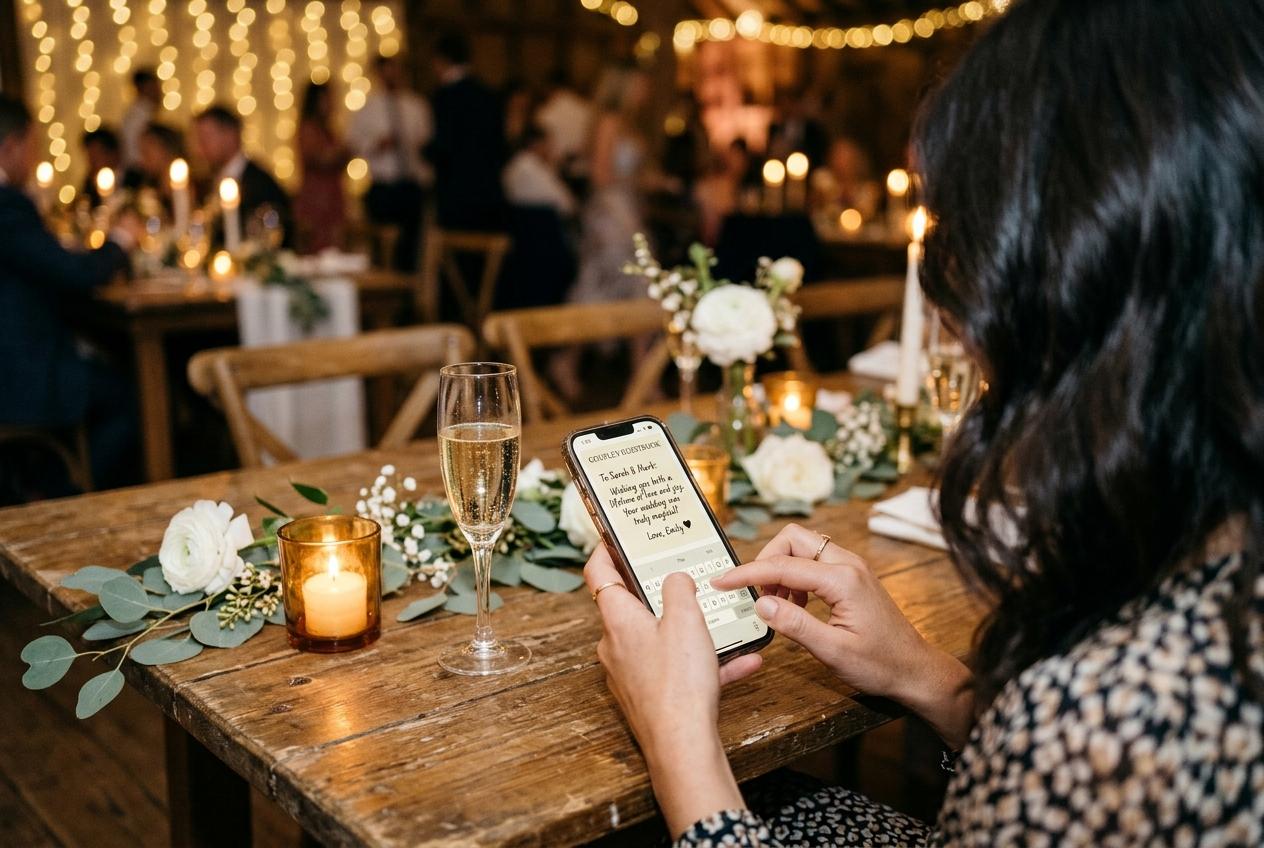
Where the pair earns its keep
- Weddings
- A hundred and fifty guests, four hours of seated boredom, and a printed stand at every table. The gallery is what makes the code worth standing on a cloth.
- Birthdays and anniversaries
- Mixed ages and one room. The code solves the reaching, the slideshow solves the showing, and the download solves the keeping.
- Conferences and works events
- Attendees who will not install anything on a device they do not own. A short address on a slide and on the lanyard card is the least intrusive way to gather the day.
- Reunions and family days
- Three generations, one or two of whom photograph everything. The door matters most here, because the people with the best pictures are the ones least likely to be handed a link.
- Graduations and showers
- Smaller rooms, longer tails. The address keeps working through the weekend, when the contributions are chosen rather than snatched.
None of it depends on the host explaining the method. That is what makes the pair worth having: the ask is physical and quiet, a card on a table, a page that already knows the name of the occasion, four small things for a guest to do, and no conversation about software anywhere in it. Everything else can wait until the morning, when you look at what arrived and reprint a sheet for the tables that were never seated.
Questions about the gallery behind the code
Is the QR code separate from the gallery?
No, and it cannot be. Every collection is created with a short address and a matching code, and the code is simply that address drawn in a form a phone can read without typing.
What does a guest see when they reach the page?
The name of the occasion, the hosts and the date, a welcome line you wrote, a picker for photographs and clips, and one field for their name. If browsing is on, the collection itself is below that.
Do guests need an account to use the address?
None. There is no registration, no password and no confirmation code at the guest end, on any plan. A name, remembered for twelve hours, is the whole of it.
Can I print the code on my own card rather than the stands?
The dashboard produces four stands on one A4 sheet, which is the shape most hosts use. The address itself is a plain string, so it can be set into your own artwork, a programme, or a welcome board as long as it stays readable.
Does the code work if the event moves indoors or the card gets soaked?
Yes, because the address behind it does not depend on the paper. Reprint the sheet, send the link as text, or type it. The collection stays exactly where it was.
Can strangers who find the code see our photographs?
They need the address, and the page is kept out of search indexes and listed nowhere. Beyond that, browsing and approval are your two controls over what a visitor is shown.
How long does the printed address stay live?
For as long as the collection is online, which each plan states in months counted from the event date. Once it closes, the card opens nothing, and the download you took is the copy that survives.
If you are holding a printed card and wondering what to do with the thing it opens, the order is short. Make the collection first, name it the way your guests would name it, write the welcome line yourself, decide whether visitors may browse, then print. The door is the last five minutes of the job and the first thing every guest touches, which is a fair description of the whole product.
Build the room before you print the door
Open a collection, name it, and the matching address and table stands are there with it. The free plan runs a real event, so you can print a sheet and watch the room fill the page.
How it works
Put one link on the tables and let everyone contribute.
Create a collection, print the table stands, and the photographs your guests took are waiting for you the morning after. Guests never install anything and never make an account.