
The chase
Collect wedding photos from guests before they scatter
The window for getting photographs out of a wedding is the wedding itself. Here is how to collect what the room took, in the order it actually works, without becoming the couple who nagged people in March.
By the second Monday, the photographs of your wedding are buried under a weekend, a work week and somebody's holiday. Collecting them is not a persuasion problem. It is a scheduling problem, and the schedule is measured in hours, not months.
The window is the evening, not the fortnight after
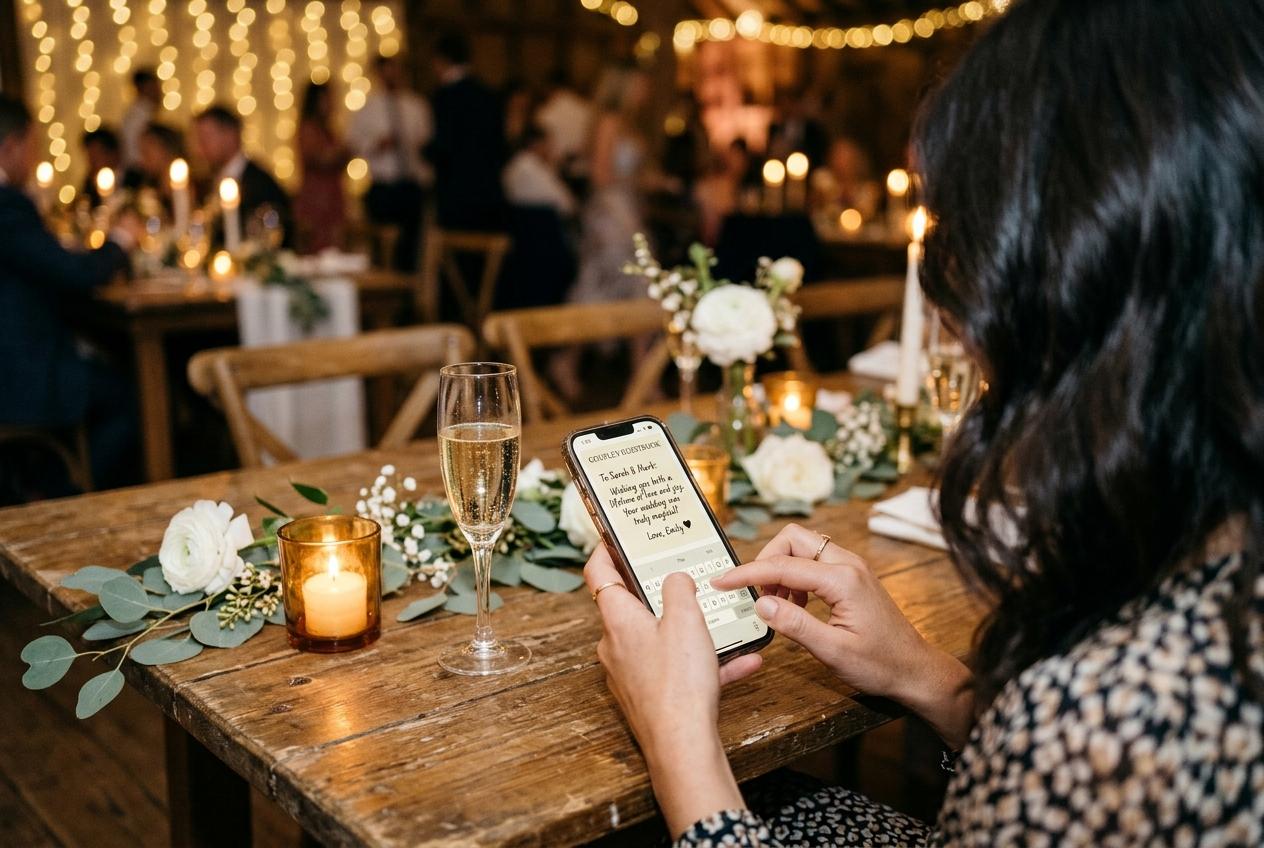
Hanna and Viktor tested both versions, on two different weekends in the same year. At Viktor's sister's wedding they did the polite thing: a message in the family group on the Sunday, asking for pictures. Eleven photographs arrived, six of them from the same cousin, and the ceremony was not among them. At their own wedding four months later, a card sat on every table and a sentence was read out before supper. The collection held more files than they had room to look at, and the best one of the vows came from a neighbour in the back row who had no intention of sending anything to anybody.
Nothing about the guests changed. What changed is when the request reached them.
The request that comes after
- Photographs are buried in a camera roll that has moved on.
- The guest cannot remember which frames were worth sending, so they send none.
- Attaching files to anything feels like a task, and tasks get postponed forever.
- Nobody knows what you still do not have, so nobody fills the gap.
- What arrives is compressed, out of order, and missing the two clips you wanted.
The request that sits on the table
- The picture is at the top of the recents and the guest still remembers taking it.
- Choosing six frames from today is a decision, not a search.
- Sending costs four taps, which is less effort than deciding not to.
- Every submission carries a name, so you can see whose camera is still closed.
- Files land as they left the camera, stills and clips together.
This is the difference between a wedding collection of twenty files and one of several hundred, and it has nothing to do with how much your guests like you.
Put the ask where the phone already is
Collecting wedding photographs from guests is mostly placement. The request has to be physically in front of a person during the two hours they are seated, bored, and holding a phone.
One on every table
This is the minimum that works, and it is not optional. A stand at the entrance is glanced at twice by people walking past it; a stand on a table is in front of twelve guests for two hours. Four stands print on one A4 sheet from the dashboard, on an ordinary printer, so the cost of covering every table is a ream of paper.
One at the bar, one by the cloakroom
These catch the three groups who never sat down: the people who arrived late, the ones who left early, and whoever spent the evening standing up. They are also the people with the photographs of the dance floor, because they were on the dance floor.
One where people wait
The cake table, the photo wall, the doorway to the garden. A queue is a captive audience with nothing to read, and a guest standing in one will scan a card.
The address as text, next to every code
For the guest whose camera will not focus on small print, the guest who does not trust codes, and the guest who will do it from a train on the Sunday. The same collection, reached two ways.
What to say out loud, from the top table
One sentence, delivered before the food, repeated in writing, and phrased so a guest could repeat it to the person beside them. This is the part hosts skip because it feels like admitting you want something.
- Say where the photographs go: the card on your table sends them to one album that we keep.
- Say what happens next: they are playing on the screen behind the band as they arrive.
- Say the small print that removes hesitation: no app, no login, nothing to install.
- Ask for a handful rather than everything, because a guest who is asked for six frames will find six.
- Do not make it the last item in a long speech, and do not make it a joke about how many photographs everybody took.
Thirty seconds is enough. A longer speech is the version people forget, and it costs you time with guests who came to see you.
The room will not remember your link. It will remember the sentence you said and the card in front of its plate.
Watching the collection fill between courses
Two looks at your phone, roughly ten minutes of attention each, is what turns a slow first hour into a full collection. The first is before the main course and the second is before the last dance.
During the drinks
Expect a handful, and upload one yourself
The first files are the eager ones: the venue, the table setting, the arrivals. An empty page makes a guest unsure whether the link is real, so put something in it yourself beforehand. This is also the moment to check that the address on the card actually opens the page, while there is still time to print more.
Before the main course
Accept anything waiting, and notice what is missing
With approval on, submissions sit invisible until you accept them, so a collection that looks ignored often has thirty photographs on a screen nobody opened. Take them through in one pass. Blur, somebody's elbow and a shot of the floor go; anything a person would be pleased about stays.
Before the last dance
Say the number out loud
One line to the room, in the same voice you used for the toast: two hundred pictures already, keep them coming until we close the album. Naming a count tells a guest that the thing is working and that there is still time, which is the pair of facts that prompts the final wave.
Monday morning: naming the gaps instead of begging
The next morning is the last moment a gap can still be filled cheaply, and the trick is to describe the gap rather than ask for photographs in general. One message, sent once, to the people who matter, and then let it be.
- Send it two or three days after, when phones have been cleared out but the day is still recent.
- Put the address in as text, not as a picture of the code, since the people who never scanned it are the ones you are writing to.
- Name what you are missing: we have nothing from the ceremony and nothing of the readings.
- Give the closing date, because a date is the only reason anybody does a favor like this promptly.
- Ask the two guests you know shot hundreds of frames for everything they took, not a selection, and say it privately.
The guests who took photographs and sent nothing
There is always a group holding frames you will never see: the couple who arrived late, the uncle who does not trust anything with a code on it, the friends who left before the speeches and went to a different bar. Some of them are reachable. Some are not, and worrying about them costs more than the photographs are worth.
Reachable by text, not by QR
These are the guests who were on their phone all evening for other reasons. A plain link in a message, sent the following week with the date attached, converts most of them. They were never refusing; they were never asked in a form they would use.
Reachable only through one of their own table
A guest who distrusts codes will still do what the person beside them did. This is why the slideshow matters even as a collection tool: watching their own photograph appear on a wall is the only persuasion that works on the sceptical ones.
Genuinely unreachable, and fine with it
Some people took no photographs, some deleted them that night, and one guest in a hundred will send nothing to anybody ever. A wedding collection of a few hundred files from sixty contributors is not a shortfall. It is the day.
Handing your photographer the room's frames
The conversation most couples skip, because it feels like admitting their photographer missed something. They did not. They were standing in one place with two eyes, and the day happened all around them.
- Before the day
- Tell them the room is uploading and give them the address. Photographers are usually delighted: a second angle of the first dance from row nine is the frame they get asked for in the edit, and it costs them thirty seconds during setup to put a stand on the table where they work.
- During
- Ask them to keep one eye on it. A photographer who notices that nobody has shot the ceremony from the back can mention it to the four people standing there, which is a faster collection method than anything a host can do from the top table.
- After
- Hand the download over rather than forwarding twenty files from a chat. The archive is one streamed file containing everything, each submission attached to the name of the guest who sent it, and originals on Celebrate and Keepsake.
- If a planner ran the day
- Open the collection in your own account rather than the planner's, so the closing date, the approvals and the download are yours to manage. Approval on and the gallery hidden is the ordinary etiquette when somebody else is holding your photographs.
Counting files against the plan you bought
The ceiling on a wedding collection is never the number of guests; on every paid plan contributors are unlimited. It is the number of files the plan holds, and a room of a hundred and forty people photographing enthusiastically reaches that number faster than couples expect.
- Preview · free
- 20 photographs and 10 contributing guests, online for 7 days, no video and no downloads. Not a wedding's plan; a rehearsal at the engagement dinner, perhaps.
- Gather · $19
- 200 photographs, 30 clips, unlimited contributors, six months online. Right for an elopement or a courthouse day with thirty people in the room.
- Celebrate · $39
- 750 photographs, 100 clips, twelve months, video guestbook and live slideshow included, original-quality downloads. The tier built for a room that is photographing.
- Keepsake · $69
- 2,000 photographs, 300 clips, 24 months, premium themes and two extra people helping to run the collection.
- Room to spare
- Extra uploads cost five to fifteen dollars and lift the file ceiling; six or twelve more months of retention can be added to a collection that is still open.
A collection that runs out of room stops accepting uploads
The ceiling is a hard one, so watch the count on the night rather than discovering it in the taxi. If the number is climbing fast, the fix is to add uploads before the room goes home, not to ask guests to send less. Duplicates of a moment already covered are the files that fill a wedding album first, and they are the cheapest ones to give up.
What each plan holdsWhat a full wedding collection holds when it closes
The point of chasing is not a bigger number; it is a set of files you can actually use, with names on them, that outlives the page.
- Every photograph as it left the guest's camera, with a preview drawn on their phone for the grid.
- The clips, from the same submission, on any plan that takes video.
- The contributor's name on each submission, which is how a mystery photograph becomes a person you can email.
- Written guestbook messages, and recorded video messages where the plan includes them.
- Nothing you refused: rejected submissions stay out of the archive.
- One streamed download of the whole set, or individual files when somebody wants one picture in April.
The chase, answered in short form
How do you collect wedding photos from guests who will not use technology?
You do not ask them to. The card on the table does the asking: they point a camera at it, the page opens in the browser they already use, and they choose pictures and send. The only technology required is the one they used to take the photographs.
Is it too late to collect photos a week after the wedding?
Not too late, but a much smaller haul. The collection is still open, the address is still in messages and browser history, and a specific ask about a specific gap still gets files. It will not be anything like the set that arrives while the room is still in it.
Should guests be asked for everything they took?
Ask the room for a handful and ask the three enthusiastic shooters for everything. A guest who has to scroll through forty frames to decide will close the page; a guest choosing six takes thirty seconds.
What if two guests sent the same moment?
Keep both in the download and sort them afterwards. Six frames of one kiss from six angles are not six copies of one photograph, and the frame you want is usually the one nobody else was standing where they could take.
Can you collect video of the speeches as well as stills?
Yes, in the same submission, on any plan that includes video. Clips are the first thing a weak venue connection struggles with, so the film of a toast often arrives from a hotel room the next morning rather than from the room itself.
How long should the collection stay open after a wedding?
Every plan already decides this: seven days on the free tier, six months on Gather, twelve on Celebrate, twenty-four on Keepsake, and six or twelve more months can be added. What matters is downloading in the first week and treating the closing date as the real deadline.
Open the collection before the photographs are taken
A collection that exists two months out can be printed, announced and tested on a real page. One you open on the Tuesday after is a request you have to make twice.
Wedding photo sharing
Put one link on the tables and let everyone contribute.
Create a collection, print the table stands, and the photographs your guests took are waiting for you the morning after. Guests never install anything and never make an account.