The other cameras
The candid pictures nobody hired anyone to take
Wedding pictures from guests are the frames your photographer was never standing where she could take them: the aisle from row nine, the laugh in the corridor, the room before anyone sat down. They already exist. The only real question is how they reach you.
Guest photographs from the ceremony, the speeches and the dance floor.
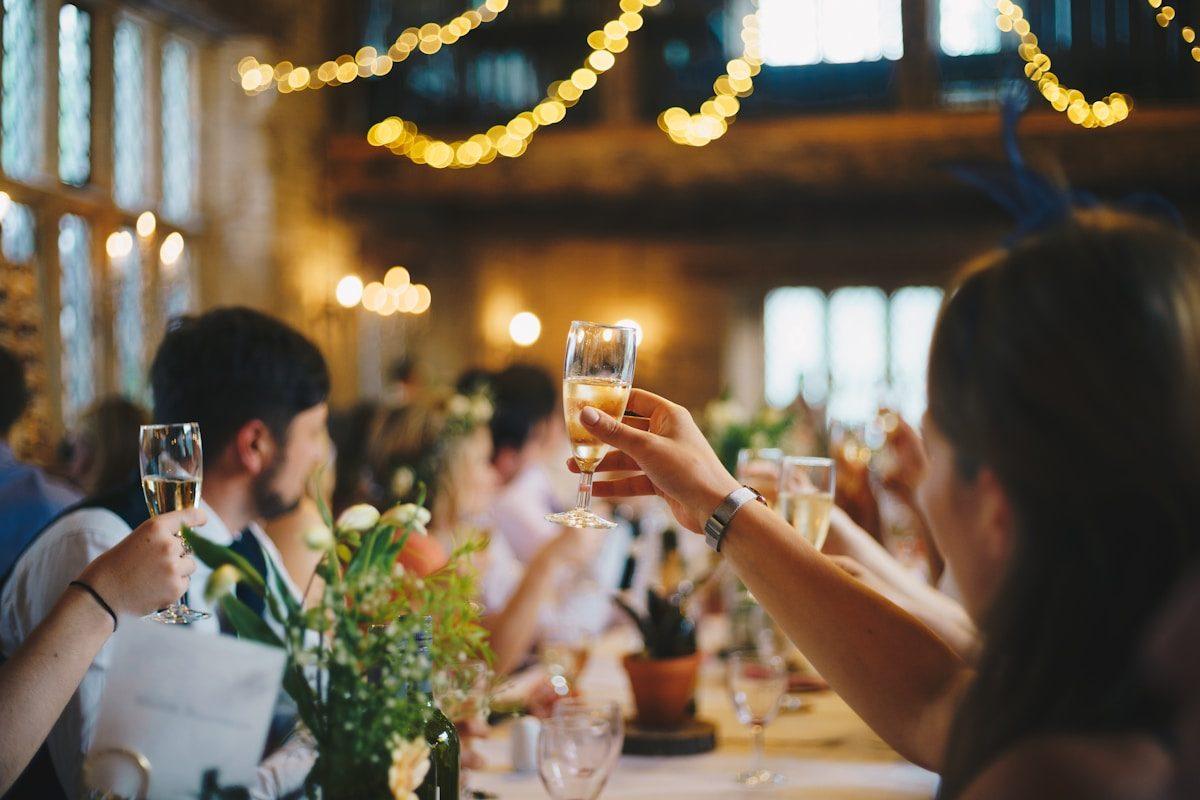
You already know which photographs of your wedding you do not have. Everyone does, eventually. The ceremony seen from behind your own guests' heads. Your grandmother's hands on the bouquet. The preparations nobody photographed. None of it is lost in a poetic sense; it is sitting in camera rolls right now, belonging to people who had no obvious way to hand it over.
What the guest cameras actually hold
A wedding gets shot from a hundred and fifty positions on the day, and exactly one of them is being paid.
Sofie and Anders had a photographer who did her job beautifully, and the delivery covered every moment anybody could plan for. It did not cover the flowers Anders's grandmother had arranged over two evenings; by the time the photographer was in the room they were background. Three guests photographed those flowers from three tables, because they were the kind of detail people notice when they are sitting still and not working.
The ceremony from the seats
Guests facing you hold the one angle nobody else has: the aisle shot that takes in your walk and your arrival in one frame, the readings seen from row six, the exit as a corridor of hands.
The waiting
The queue at the bar, the garden before the toasts, the doorway as the room opens. Time a couple experiences once and never photographs, and a seated guest shoots because there is nothing else to look at.
The details somebody chose personally
The hand-tied bouquet, the shoes, the chair sashes an aunt made at her kitchen table. The people who made these things photograph them, and their photographs carry a sentence of context no commissioned set will ever include.
The faces watching
During the readings and the speeches, your guests photograph other guests. The frame of your father trying not to cry comes from the person who was sitting next to him, because that is the only seat with that sightline.
The end of the night
Whoever stayed upright at half past midnight is holding the version of your wedding that ended: the shoes by the door, the table wrecked, the last dance shot from the floor rather than the stage.
Why these frames never arrive on their own
Nobody plans to withhold photographs from your wedding. The mechanics are far more ordinary than that. A guest goes home, the frames sink under a weekend and a working week, and by the time anybody remembers, the phone is full of receipts and school runs. Asking becomes slightly awkward, so it becomes an email draft that is never sent, and the moment passes for the year.
The hesitation underneath is also reasonable. Most guests have taken far more frames than they believe are worth sending, and nobody wants to be the person who dumped four hundred pictures on a bride. Attaching files to a message feels like homework, and the messaging app squeezes them anyway, so the considerate ones decide the whole business is not worth the trouble and say nothing.
- Getting the files out
- Selecting frames, attaching them, watching a progress bar is a sequence of decisions, and every decision costs a guest who has stopped thinking about your wedding.
- Knowing where they go
- A request without a destination gets postponed. A card with a code on it is a destination, and it removes the question of what to do with the photographs instead of generating one.
- Keeping the names straight
- Anonymous files are a small grief: in April you know the photograph is wonderful and have no idea whose camera it came from, which is the wrong time to find out.
- The awkwardness of asking
- A guest should not have to wonder whether the request is still open. A page that stays available, and says so in one line, lets the ask outlast the evening without anybody repeating it.
The ask that costs a guest forty seconds
Everything here works or fails on one measure: what the request costs a person who came to watch you rather than do paperwork. A stand on the table with a code on it opens a browser page. No app, no account, no password, at any level of the product. A guest chooses frames, gives a first name once, presses send, and goes back to the table, and the page remembers who is typing for twelve hours, so a second batch that evening costs nothing at all.
The phone's own camera reads the card
There is no scanner to find and nothing to install. The camera application guests already use to take the photographs is the same one that opens the collection, and the address sits beside the code as text for anyone whose focus is failing at nine p.m.
The page says whose wedding it is
Your names and your date sit at the top, above the welcome line you wrote. This is the two seconds in which a guest decides whether the link is real, and it is answered with paper rather than persuasion.
Frames are chosen from the recents
The picker opens on the album the phone already sorted into today. Photographs and clips go into one submission, so a guest who shot the toast as a video does not have to find a different button for it.
A name, once
One field, the only thing asked, because it is the only thing worth the cost. It tells you whose camera a frame came from, which converts a mystery photograph into a person you can thank.
Send, and back to the table
A receipt confirms the submission arrived. Nothing needs to stay open, nothing needs verifying by email, and there is no reason for the guest to remember any of it happened.
The candid half of your wedding is already photographed. The missing piece was never enthusiasm. It was a way to hand things over that costs less than the awkwardness of keeping them.
Blur, backs of heads, and the keeper in the middle
A guest set arrives unsorted, and that is the bargain. Ask a room of a hundred and twenty people for a handful of frames each and the arithmetic is obvious: several hundred files, most of them ordinary. The keeper in the middle is the frame your photographer could not stand where she could take. The volume is not the collection's flaw; it is the shape of a day seen from a hundred and fifty positions, and the tidying belongs to a quiet evening at a desk, not to a room that is dancing.
- Ask the room for a handful rather than everything, because a guest faced with forty frames will close the page rather than scroll.
- Ask your three serious shooters privately for everything they took, and say why: you would rather choose than guess what was left out.
- Decide before the day whether submissions show as they arrive or wait for you, so the choosing happens on your schedule and not at the table.
- Download once, as one archive, instead of saving frames out of the gallery each time you find one you like.
- Keep the contributor names: the gallery credits every frame to its sender, and that name is the difference between a photograph and a person.
- Curate at a desk in the second week, while you can still remember who was standing where.
Duplicated moments are not duplicates. Six frames of one kiss from six positions are six angles.
Video that only the room was standing near
The speech nobody filmed is gone in a way a blurry photograph of it is not. Clips of the toasts, the first dance from the floor, the band, the chaos of the last hour: these live on phones for about three days before they are deleted to make room for a commute. Guests send video from the same picker as stills, in the same submission, on any plan that takes clips. The ceilings are finite and known in advance: Gather holds 30 clips, Celebrate 100, Keepsake 300, and the free plan takes no video at all.
- One clip of one speech, from whoever sat nearest the speaker.
- The room as you walked in, from the back, where the whole picture fits.
- The first dance filmed from your parents' row rather than the stage.
- Anything from the end of the night, from whoever was still standing.
- A message recorded to camera for the relatives who could not travel.
What you settle before the room starts shooting
A stranger's camera inside your wedding is still your wedding. Four controls decide what the guest set does after it lands, and the pleasant news is that all four are switches you set calmly in advance, in a kitchen, rather than at eleven on the night.
- Approval
- A control on the collection that you turn on; it starts off. With it switched on, a submission waits quietly until you accept it, and anything you refuse stays out of the gallery, off the room screen, and out of the download.
- Browsing
- The public gallery can be switched off, and the guest page becomes upload-only: people send their frames and cannot look through what anybody else sent.
- Names
- Every submission carries the name the guest typed. It is the quiet control that makes the rest work: without it, a guest set is a pile; with it, the set has authors.
- The closing date
- Every plan states how long a collection stays online from the event date, and warning mail arrives before anything is removed. What survives the collection is the download you took.
Guests never pay, and never register
The plan you choose changes how many files the collection holds and how long it stays up. It never changes what a guest is asked to do: a name, some files, one button, on the phone they brought with them.
See what each plan holdsWhose camera is whose, and why it matters in April
The frame you want in March is usually the one you cannot place. Who took the only good photograph of your father during the readings? The submission list answers that, because every file arrives with a name attached, and a name turns an uncredited photograph into a person you can message. It also shows the shape of what is missing: if nobody from your side of the family has sent anything, that is a Tuesday-evening question for four specific people, not a mystery.
There is nearly always one guest who shot the whole day on a real camera and feels awkward mentioning it. Ask that person privately, after the day, for everything rather than a selection: two hundred frames you can sort beat forty chosen for you at midnight, because the frames people thought were throwaway often include the corridor, the lift and the car park at closing.
The first week, while people still remember
Sunday morning
One pass through everything waiting
Take the submissions in a single sitting while the day is still a story you can follow in order. Blur, elbows and floors go; anything a person would be pleased about stays. The choosing takes twenty minutes now and a whole afternoon by the fourth week.
Two or three days out
Name the gaps, once, by text
A short message with the address written out and a specific hole in it: nothing from the ceremony, nothing of the readings. The people who never scanned a card will tap a link at breakfast, and a date attached to the request is the only reason favors like this happen promptly.
Inside the first week
Take the whole download
One streamed archive of everything that stayed in, or individual files when somebody wants a single picture. Do it while the contributors are still willing to answer questions about which frame is which, and copy it somewhere the wedding exists twice.
Well before the closing date
Write the date down and stop worrying
The collection has a lifespan by design, and warning mail comes before it ends. A guest set with an end date gets downloaded; the one nobody wrote down becomes a bookmark folder in the second year.
Straight answers about the guest set
Do wedding pictures from guests mean giving up control of what shows?
No, and the control is one switch. Approval is something the host turns on, and it starts off; with it on, every submission waits invisibly until you accept it, and refusals never surface anywhere, including in the download.
Will guests send the terrible photographs too?
Yes, alongside the ones you will treasure. A guest set arrives unsorted because it is a real day rather than a planned shoot, and the fix is a fast first pass, not a smaller request. Asking for a handful of frames reduces the blur without losing the keeper.
Are the files squeezed down to a smaller size on the way in?
No. The file your guest chose is stored exactly as it arrived; only the small preview tile for the grid is drawn, and that is produced on the guest's own phone. When you download, Celebrate and Keepsake give the original files and Gather gives standard downloads of the same set.
Can the people who could not attend add anything?
That is one of the best uses of the address. A relative in another country opens the same page, sends a photograph or a recorded wish, and it lands in the one collection with their name on it, beside everything from the room.
Does the room see what everybody else has sent?
Only if you leave the gallery switched on for browsing. Turn it off and contributions still arrive while the room looks at nothing but its own tables.
Put the ask in front of the room while the day is still being photographed
Open the collection, print the stands, write the two sentences a guest reads before uploading. The candid half of your wedding is already on somebody's phone; give it somewhere to go.
Wedding photo sharing
Put one link on the tables and let everyone contribute.
Create a collection, print the table stands, and the photographs your guests took are waiting for you the morning after. Guests never install anything and never make an account.