
Walkthrough
Your wedding photographs are already on thirty different phones
The whole method in the order you would do it: open a collection two weeks out, put a code where the phones already are, say one specific thing out loud, and take the download in the first week rather than the last.
There is a version of this that works by accident. Somebody's cousin films the speech, somebody else photographs the send-off, and six weeks later a group chat produces forty files of varying quality and a nagging feeling that you have missed the best of it. This page is about the other version: the one where you decide in advance what you want, tell the room in words it will actually act on, and end up with an archive you can open on any laptop in ten years. It takes about twenty minutes of setup before the wedding and about four minutes of attention on the day, and none of it depends on which photographer you hired. The photographs you are chasing are not professional ones. They are the frames only a person sitting at table nine could have taken, and the reason those frames go missing is almost never unwillingness. It is friction: the file is three taps away on a phone that is at eleven percent battery, in a room where nobody has explained where anything goes.
What you are actually trying to gather
The angles your photographer could not be in
A professional works the room from outside it. Guests shoot from inside the seats, which is why their files hold the reaction rather than the event: your mother during the vows, the table of friends laughing at something the speeches said, the queue at the bar at half past eleven. Two cameras in a room see two different weddings.
The moments nobody was asked to photograph
The nervous twenty minutes before the ceremony, the packing of the gifts, the last dance with the lights up. These are not on any shot list, and the only reason they survive at all is that a guest happened to raise a phone.
The clips, which are a separate problem
Video is what a messaging app destroys first: compressed twice, buried in a thread, gone from the scroll by Sunday. Anything you want filmed needs to arrive as a real file, which means a path that is shorter than the chat you would otherwise use.
The names attached to all of it
A photograph with no name on it becomes a mystery within a year. A contributor gives their name once and is not asked again for twelve hours, which is enough attribution to remember who shot what and who still has more on their camera roll.
Two weeks out, open the collection and decide what it takes
Create it before the invitations are printed
The link and the code have to reach the same paper as the address of the venue, which means the collection exists at least a fortnight early. Setup is a handful of fields: the occasion, the date, the welcome line, whether the gallery is open to everyone holding the address or upload-only.
Choose a plan by how much footage you expect
The free Preview collection holds twenty photographs, ten contributing guests and comes down after seven days, with no video and no downloads — a rehearsal of the settings, not the real thing. Gather holds 200 photographs and 30 clips for nineteen dollars, Celebrate 750 and 100 for thirty-nine, Keepsake 2,000 and 300 for sixty-nine. One room of eighty guests can produce four hundred photographs by dessert.
Write the welcome line as a request with a reason in it
Every contributor reads it at the moment of decision. Naming what you want — the speeches, the dance floor, anything the photographer could not see — gives a guest something to look for. Asking them to upload their photos gives them a chore.
Decide whether you want to see entries first
Approval is a switch on the collection settings and it starts off. With it off, contributions go straight into the gallery and onto the room's screen. Most couples running a projector switch it on, because a projector is a large way to show somebody a photograph they did not consent to.
Set the closing date with the ask in mind
Retention is counted from the event date: six months on Gather, twelve on Celebrate, twenty-four on Keepsake, with paid extensions. A collection that stays up a year is worth it for the guests who fly home and the relatives who record late, not for you.
The printed code is the entire distribution plan
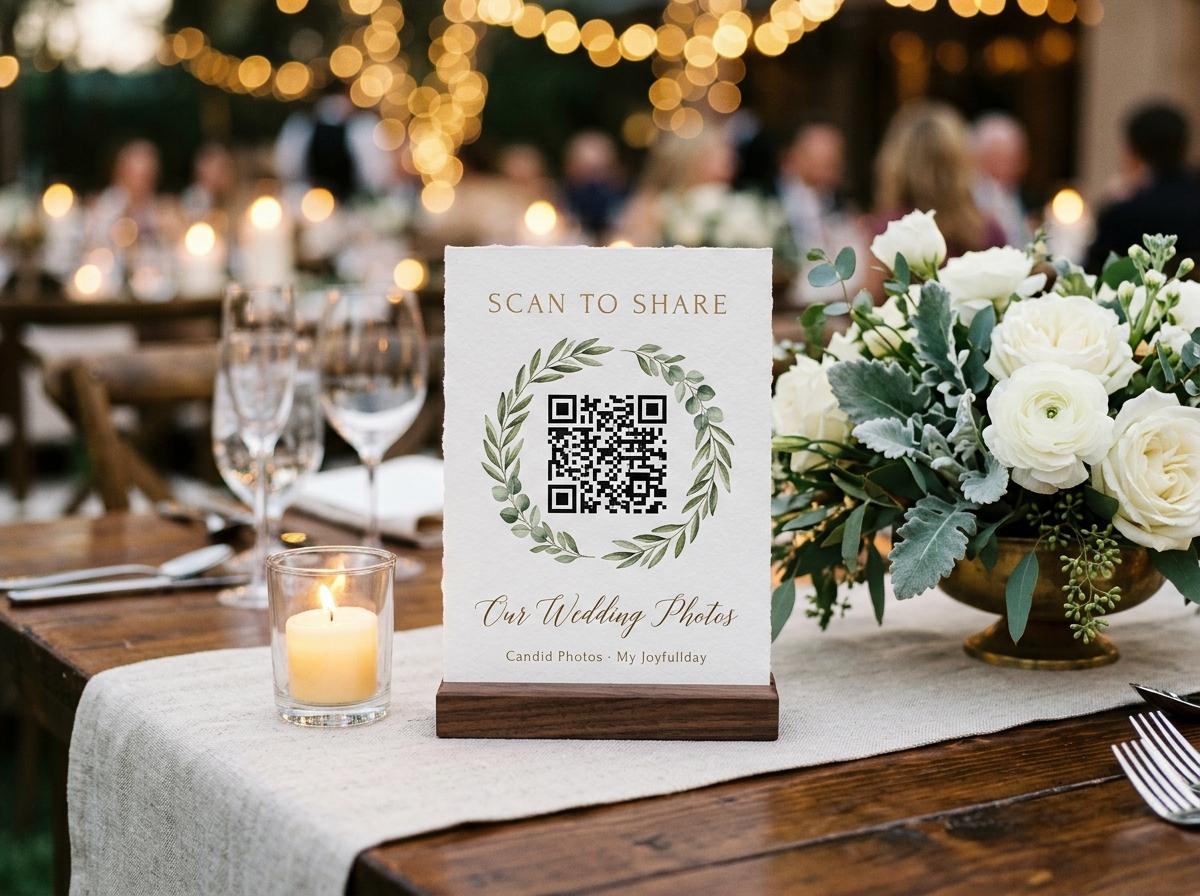
- Four stands to one sheet of paper
- The dashboard prints four table cards on an ordinary A4 sheet from an ordinary printer. Nothing special about the paper matters; being able to reprint a torn one three days before the wedding matters a great deal.
- Tables first, then the two places people stand
- Put one on every table, then the bar and the door on the way out. A surprising amount of footage is made standing up by somebody who never sat down once, and the send-off photographs happen in a doorway.
- Face them the right way
- A card that faces the flower arrangement photographs nobody. If somebody else is laying the room, hand over the stands with one written instruction: upright, on each table, facing the far side.
- One code, one address, no second link
- The same page takes photographs, clips and written messages, so there is nothing to explain and nothing for a guest to choose wrongly. A second address for the guestbook is how a book ends up with four entries.
- The address is not public
- Guest pages are kept out of search indexes and the link is not listed anywhere, so the only way into the collection is the one you handed over. That is what makes it safe to print on paper that ends up in a coat pocket.
What to say, in writing and out loud
A request made once, badly, in front of a room that is hungry, produces nothing. The same request in three places — the invitation wording, the programme, the toast — produces a gallery. What follows is the shortest version of each that still gets read.
- In the invitation: one line and the address, no explanation of how it works. A guest reads this on a train and remembers nothing but that there is a place to put pictures.
- In the programme: the request for photographs and clips, one named moment, and the date the collection closes. Programmes get read at tables for twenty minutes at a time.
- In the welcome speech: thirty seconds, with a gesture at the screen if a slideshow is running. Say what you are hoping to see rather than that you are hoping to see things.
- From the best man or the person with the microphone: the specific ask. Somebody with a microphone gets four times the contributions of a card on a table.
- On the day itself: tell the tables that are nearest the action. The guests who were going to hesitate will do it if a person they know asks them to.
- In the first message afterwards: one thank-you, the address again, and the closing date written as a date rather than as a phrase.
Every line is a request for footage, not instructions. The page explains the taps in one screen; your words have to explain what is worth the taps.
On the day, the four windows that fill a gallery
The drinks reception
The only quiet chance you get
People are standing, holding phones anyway, and not yet absorbed by the ceremony. Mention it twice, to two different groups, and the first dozen contributions arrive before the seating.
Between the courses
Two minutes with nothing to do
Seated guests have their phones out and a gap in front of them. This is when the photographs of the table, the cards and the flowers arrive, and it is why a stand within reach does more than an announcement nobody heard.
The speeches
The video spike
Every phone in the room goes up at once, and this is where an allowance runs out if you picked the smaller one. Look at the collection before the main course so you know whether the room has already filled it.
The last hour
The doorway and the send-off
The stand by the exit earns its keep here, because a guest who has just had a wonderful evening and is holding a coat will scan if the code is at the door rather than on a table in another room.
The morning after, and the second ask
Look before you write
Fifteen minutes with the gallery open tells you what is missing. That converts a vague thank-you message into one specific request, and specific requests retrieve specific files.
Name the gap, in one message
Nobody has sent the ceremony, nobody has sent the garden, nobody has sent the send-off. The guests who filmed those things will find them within an hour, because the description matches something they remember holding.
Ask the two individuals separately
The cousin who films everything and the friend who said she was going to send something. A private message with the address in it works where a group message does not, and it is not a reminder so much as a favour.
Give the people who were not there a week
Relatives who could not travel, and the colleagues who left early, usually send the best material on the third or fourth day. The link works away from the room, so there is no reason to hurry them.
Take the archive once the set is finished
One download, every file as it arrived, each of them still credited to its sender in the collection. Take it when the last expected pile is in rather than in the final week of the retention period, so nothing has to be collected twice.
What to keep, and what to stop worrying about
- Blurry is not the same as worthless
- Half of what arrives will be technically bad and emotionally perfect. The rule worth keeping: a photograph of a person you love being interested in something is worth storing even when the horizon is crooked.
- Four versions of one moment
- Choose the steady one and delete the rest while you can still remember which angles you preferred. Sorting four hundred files a year later costs an evening you will resent.
- The files you will never open
- The forty-second clip of an empty dance floor, the six shots of the same cake. Nothing about the collection is diminished by your removing them from your own copy afterwards.
- One copy somewhere that is not a laptop
- The archive you downloaded is the only version that outlives the collection. A drive, a second machine, or a photo subscription — anything other than the folder you happen to open every day.
Nobody at your wedding is withholding a photograph. They simply never had a short enough way to hand it over.
Where this goes wrong on the first attempt
The link arrives too late to print
A collection opened on the Tuesday for a Saturday wedding has no stands on the tables, and stands are what a room uses. Everything else about this depends on paper being somewhere people look.
Nobody says it out loud
A card on a table is read by the polite and ignored by everybody else. One sentence in the welcome doubles what arrives, which is the cheapest improvement available to you.
The ask is general instead of specific
Share your photos is a chore with no deadline. Film the speeches and leave us a message is a task a guest can complete and remember having completed.
The download is left to month eleven
Retention periods end, warning mail arrives first, and after that the archive you took is the only copy. Couples who mean to download it in the last week sometimes do not get to the last week.
Questions people ask before they try this the first time
Do my guests need to install anything?
No. The code opens a browser page on the phone already in their hand, and photographs and clips can travel together in one submission. Nothing to install, no account to create.
How many photographs will a wedding room actually send?
More than you expect from a room that was told what you wanted, and far fewer from one that was not. What you control is the allowance on the plan you chose and the words you used in the ask.
Will this stop my photographer doing her job?
No, and most professionals prefer it. Their set arrives separately as their own contribution, and everything the guests shot is material they were never positioned to take.
Can I see the files before other guests do?
Yes. Approval is a switch on the collection settings, off by default. With it on, a submission waits until you accept it, and anything you turn down is left out of the archive as well as the gallery.
What if the venue wifi is hopeless?
The preview tile for each file is made on the contributor's own phone, so the gallery can hold several hundred images and still open on a bad connection. A guest can also send later from home; the address works away from the room.
Do I need a second link for video?
No. Clips and photographs go into one collection from one page. What you do need to check is the video allowance, because the smaller plans carry fewer clips than photographs.
Is it worth paying for a plan rather than using the free one?
For a real wedding, yes, and mostly for the downloads and the retention period. The free collection holds twenty photographs, comes down after a week and gives you nothing you can keep.
What happens to files a guest later regrets sending?
You can remove them from the collection, and with approval switched on you will usually have caught them first. This is a small thing that people feel strongly about, and it is a good reason to keep the address to yourself.
Set it up while there is still time to print
Open a collection, print the stands, and write one line about what you would like to see. The free plan runs a real event so you can watch how it fills before you commit to a date.
Guides and comparisons
Put one link on the tables and let everyone contribute.
Create a collection, print the table stands, and the photographs your guests took are waiting for you the morning after. Guests never install anything and never make an account.