What to try
Wedding photo sharing ideas, sorted by what they cost you
Nineteen things people actually do, from a sentence in the welcome speech to a screen in the corner. What each one changes about what arrives, and which sound better than they turn out to be.
The difference between a wedding with four hundred guest photographs and one with eleven is almost never the crowd. It is whether the room was told, where the telling happened, and whether the path from a camera roll to your hands was shorter than the path to a group chat. The ideas below are ordered by what they cost rather than by how clever they sound, because the cheap ones work and the expensive ones mostly become decoration. Run three or four of them, not all nineteen, and put the effort into the sentence somebody says out loud rather than into anything printed twice.
Ideas that cost nothing but a sentence
Thirty seconds in the welcome
The highest-yield thing on this page and it is free. Say what you would like to see, name the two or three moments, and point at the screen if one is running. A room that hears a request once contributes about twice what a room that reads one contributes.
The specific ask from whoever holds the microphone
A best man or a celebrant with a microphone can ask for the speeches by name and get forty entries. The same words on a printed card get six, and four of those come from the same family.
Naming one gap the next morning
By then you know what is missing, so one message can ask for exactly it: nobody has the ceremony, nobody has the garden, nobody has the send-off. A specific request retrieves a specific file from a specific phone.
Telling the tables nearest the action
The guests who were going to hesitate will do it if a person they know asks them directly. This costs a sentence at dinner and beats every clever thing you could print.
Asking for advice rather than congratulations
For recorded messages specifically. Almost nobody knows what to say as a wish; everybody has one thing they wish somebody had told them at twenty-eight, and it takes forty seconds to say.
Ideas that need a printer
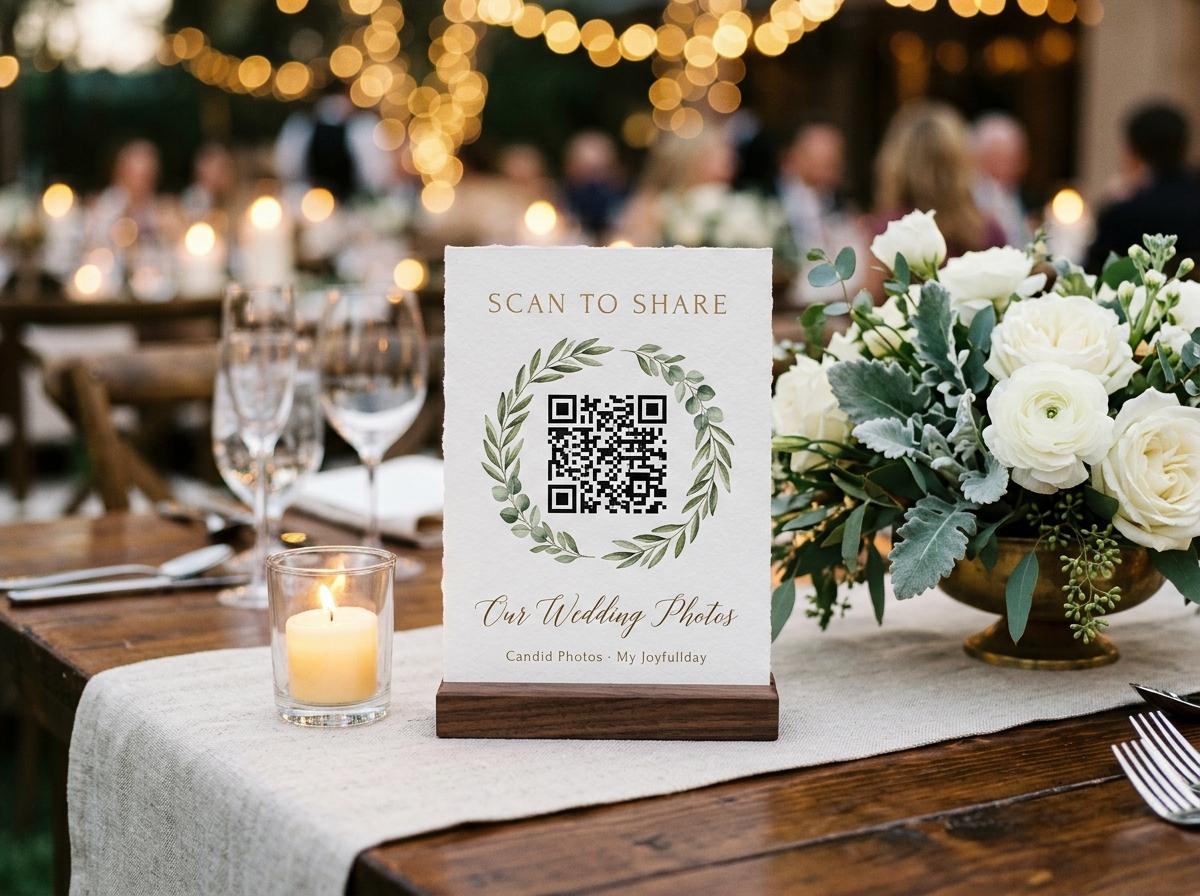
- A stand on every table
- Four cards print on one sheet of ordinary paper from the dashboard. It is the baseline of everything else here: a code within reach of a seated guest converts the two minutes they have nothing to do into contributions.
- One by the bar and one by the door
- More footage is filmed standing than sitting, and the send-off happens in a doorway. Two cards in the places people stand are worth more than twenty on tables they leave at nine.
- The line in the programme
- A programme is read at a table for twenty minutes at a time, which makes it the second-best printed surface after the table stand itself. One line, one address, no explanation of how it works.
- A card in the welcome basket
- For a weekend wedding or a destination one: the address in the room where people arrive, when they have thirty quiet minutes and their phone is already out.
- The invitation wording
- It has to be decided a fortnight out, because that is when the paper is printed. It does very little work on its own — a guest reads it on a train and forgets it — but it makes the printed code look official rather than improvised.
Ideas that use a screen in the room
Play what has arrived, live
A slideshow at its own address shows the accepted collection on the venue's television or projector. Guests see their own photographs appear behind the cake table, and then tell the person sitting next to them, which is the only viral mechanism available to a wedding.
Leave it running during the quiet hours
The drinks reception and the dessert course are when people have a phone and nothing to do. A screen that is off during both loses the window when contributions are easiest to earn.
Put the code on the screen itself
Whatever people are already photographing is the right place for the request: the arch, the signage, the wall behind the band. A card on a table competes with flowers; a code beside a photographable thing gets into the frame.
Review before you project
A projector is a large way to show somebody a picture they did not consent to. Approval is a switch on the collection settings, off by default, and it is the setting worth turning on the moment a screen goes up.
Ideas for the people already filming everything
- Identify them before the day
- Every room has three or four contributors who shoot everything and post nothing. Send them the address the week before and they arrive prepared rather than trying to remember at midnight.
- Give one of them a job
- Ask a friend to be the person who collects. It costs nothing, they enjoy it, and the material they retrieve from the tables you never visited is usually the best in the set.
- Tell them what happens to the files
- A guest who knows the clips go to the couple and not to a public page films differently — longer, steadier, more willing to include the grandparents.
- Ask for the boring frames as well
- The empty hall before anybody arrives, the table being laid, the car on the way home. These are the photographs that make an evening feel complete in ten years and nobody thinks to request them.
Ideas that work after the evening
One thank-you message with the date in it
The morning after, one message: what you liked, what is missing, the address again, and the date the collection closes as an actual date. It is the highest-return paragraph of the whole process.
Private asks to two named people
The cousin who filmed the speeches and the friend who promised something and did not send it. A personal message gets a reply; a group message gets a heart reaction.
A week for the people who were not there
Relatives who could not travel and colleagues who left early usually send the best material on the third or fourth day. The address works away from the room, so there is no reason to hurry them.
Take the archive in the first week
Every photograph and clip as it arrived, in one download, with the entries read out of the book separately before the page closes. After the collection comes down, that folder is the only copy that exists, and the last week of a retention period is the worst week to remember it.
Open the gallery for one viewing
Switch the collection from upload-only to browsable once the set is finished, and the address becomes the album rather than a form. Family who came round with a television and no wifi get the slideshow link.
Ideas that sound better than they perform
A hashtag
It gathers photographs and then puts all of them in front of strangers, including the one your uncle would like unremembered. It also relies on a platform keeping your wedding findable, which platforms reliably do not do, and nothing about a hashtag produces a file you can keep.
A usb drive by the door
Charming in principle. In practice a guest with a full camera roll and no laptop cable cannot use it, and the thing you have bought is a small box of photographs from four people who happened to have an adapter.
A polaroid wall
A lovely artefact and no archive at all. It captures what one person held, at the size it was printed, and none of it can be searched, downloaded or given to the cousin in Lisbon.
A request in the invitations, alone
Printed a fortnight before and read on a train. It is worth one line, and it is not a plan: without a stand in the room and a sentence out loud it contributes almost nothing.
An instruction manual on the card
Six lines about how the technology works, in a room where nobody wants to read. The page explains the taps in one screen. Your printed words have to explain what is worth the taps.
How many of these to run at once
Three, chosen from three different groups on this page: one thing said out loud, one thing printed, one thing on a screen or in the week after. Beyond that you are managing a project during your own wedding, which is the specific thing people are trying to avoid. The failure mode is never too few ideas; it is one idea executed late — a code printed on the wrong paper, a request made in a speech nobody heard, a collection left closed when the family wanted to browse it.
- One spoken request: the welcome, or whoever holds the microphone.
- One printed request: a stand on every table, plus the bar and the door.
- One screen: the slideshow running during the two quiet windows.
- One message the next morning, with the missing moment named and the closing date written as a date.
- One download, taken in the first week rather than the last.
- Nothing else. Anything further costs your attention on the day, and the day is the point.
If you do only the first and the fourth, you will still get more than the wedding that has a card on a table and no sentence spoken.
The photographs are not hidden. They are just three taps away on a phone that was never told where to put them.
Ideas for what happens to the set afterwards
- One frame, chosen by a guest
- The photograph your friend took of your mother during the vows belongs on your wall, not in a folder. Choosing it costs two minutes and it is the only part of this that gets looked at daily for years.
- The archive handed to the person who keeps things
- Somebody in the family always does. Send them the download as well as the address, because the sets that survive are the ones held by two households rather than one.
- A single page of the twenty best
- Printed, cheap, and given to the relatives who could not come. It is the version of sharing that your aunt will actually look at, and it takes an hour on a Sunday.
- A message that says where everything went
- One line in the thank-you notes: the photographs are here, the clips are with them, and the collection stays open until a stated date. Guests who were told stop forwarding files to you individually, which is worth an evening.
Questions people ask when choosing between these
Which single idea makes the biggest difference?
The spoken request. A card tells the polite and the curious; a sentence from somebody with a microphone tells the whole room, and it costs nothing to say.
Do printed codes still matter if everybody has the link?
Yes, and more than the link does. Typing an address from memory in a dim room is the point at which guests give up, and a code removes the typing entirely.
Is a slideshow worth it just for collecting?
It is the strongest encouragement available, because a guest who watches their own photograph appear on the wall tells the person next to them. The room's screen runs at its own address, an add-on at nine dollars on the smallest paid plan and included above it.
Should we ask for video as well as photographs?
Ask for both in one sentence, because a guest who is not told will send what they think you want, which is usually nothing. Clips and stills go into one collection from one page.
How early should any of this be set up?
A fortnight, because that is when printed things exist. Everything else — the wording, the review switch, the closing date — is worth deciding before you have anything to reprint.
Will guests think it is strange?
A request at a wedding is expected. What reads as odd is a request nobody explained, so the sentence matters more than the mechanism: what you would like to see, and where it goes.
What if the room ignores every idea here?
Then the morning-after message does most of the work, because the guests who meant to send something are still holding their phones. Two specific asks retrieve a surprising number of files.
Does any of this cost the guests anything?
Nothing. No price is shown to a contributor at any level, there is no account to create and nothing to install. The one thing they give is their name, once.
Pick three and write them down
One thing said, one thing printed, one thing on the screen. Open a collection, set the welcome line, and print four stands on one sheet of ordinary paper.
Guides and comparisons
Put one link on the tables and let everyone contribute.
Create a collection, print the table stands, and the photographs your guests took are waiting for you the morning after. Guests never install anything and never make an account.