Codes that meet weather
Printing a scan code that survives sunlight, wind and grass
An outdoor wedding changes almost every assumption a printed code relies on. Indoors, a sign sits on a stable table under even light and a guest scans it from a comfortable distance. Outdoors, the same sign competes with direct sun, gusts, uneven ground, a marquee wall that moves, and a mobile signal that may be weaker than the one in the car park. None of this makes the code unusable. It means the material, the placement and the fallback need to be chosen for the conditions rather than carried over from a room.
Table stands, printed codes and the scan that opens an upload page.
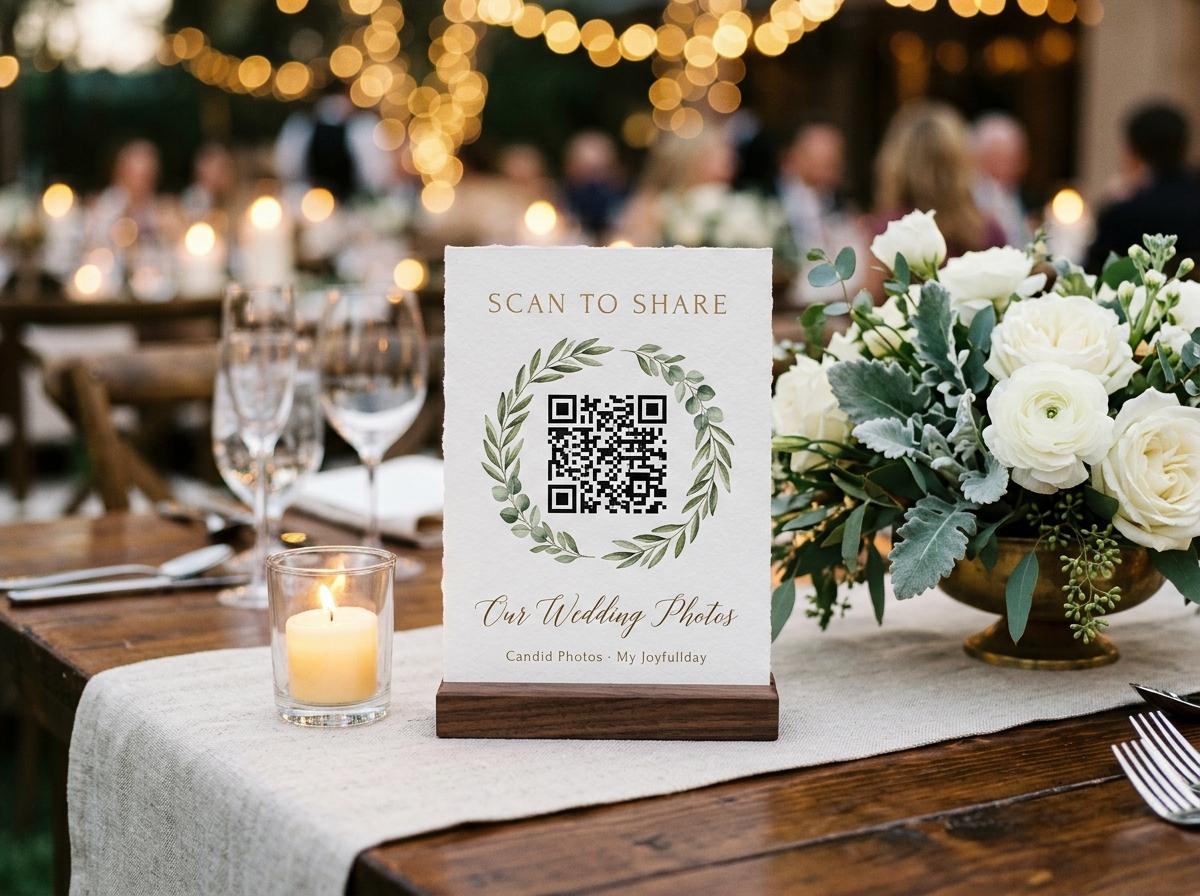
The code itself does not change because the wedding is outside. It still encodes the same guest address, and a phone that can read it in a dining room can read it on a lawn, provided the print is sharp and the surface is flat and still. What changes is everything around the code: the light falling on it, the wind trying to move it, the ground holding it up, and the connection a guest needs after the scan succeeds. Most outdoor failures are not decoding failures at all. They are a sign that blew over, a laminate that turned the code into a mirror, or a guest who scanned perfectly and then found no signal to send the picture.
Sunlight is the first problem, and it is not about brightness
What direct light actually does to a scan
- Glare from a glossy surface
- A laminated or coated sign reflects the sun straight back at the camera, and a bright patch across the squares is enough to defeat recognition. A matte finish, an uncoated card, or a sleeve angled away from the sun removes the reflection without changing the code at all.
- Hard shadow across the print
- A tree branch, a parasol strut or the edge of a marquee can cast a bar of shadow over part of the code. The camera reads contrast, and a shadow that halves the squares halves the information. Place the sign so the fall of light at the intended hour does not cut across it.
- Washed-out low contrast
- Bright ambient light can flatten the difference between the dark squares and the background, especially on a grey or recycled stock. Keep the code black on white with a clear quiet margin, and avoid tinted paper that looks attractive indoors and unreadable at noon.
- The angle of the guest's phone
- Outdoors people scan standing, often with the sun behind them or to one side, which throws reflections onto their own screen as well as the sign. A sign that tilts slightly toward the guest, rather than lying flat, gives the camera a cleaner perpendicular view.
Weather decides the material, not the design
Choose the stock for the forecast, not the mood board
Rain and dew
An ordinary printed card curls and its ink runs within minutes of a shower, and morning dew alone can soften a sign left out overnight. A sealed sleeve, a synthetic waterproof stock, or a board rather than paper keeps the squares crisp. Test the chosen material with a spray bottle before the day rather than discovering it in a drizzle.
Wind
A light tent card on a tablecloth will lift, spin and land face down, and a code nobody can see is a code nobody scans. Weight the base, use a rigid board, or fix the sign to a stable easel or stake. A sign that has to be held still by a guest is a sign that was mounted in the wrong place.
Heat and sun fade
A dark surface in full sun can soften adhesives and, over a long afternoon, a dye-based print can begin to fade. For a single event this is rarely fatal, but a sign intended to stand all week at a venue should use pigment rather than dye and avoid adhesive that will bleed in the heat.
Placement outdoors follows sightlines, not furniture
Where the code should actually stand
Map the guest flow first
Walk the route guests take from arrival to drinks to seating, and note where they naturally pause. Outdoors those pauses are the entrance, the bar, the shaded edge of the lawn and the path to the loos. A code at a natural pause gets scanned; a code in the middle of an open lawn gets walked past.
Keep it at a readable height
A sign low on a table forces a guest to stoop and puts the code at an oblique angle. Mount it near standing eye height on an easel, a marquee pole or a shepherd's hook, where the camera meets it square-on without anyone bending.
Give it a clear background
A code placed against busy foliage, a patterned rug or a crowd reads worse than one against a plain board. Put the print on its own backing so the quiet margin around the squares is genuinely quiet, with no leaves or text crowding the edges.
Protect it without hiding it
A sheltered spot under a marquee avoids rain and direct sun, but a deep shadow can be just as bad as glare. Aim for even, indirect light: open shade rather than a dark corner, and never a reflective surface immediately behind the print.
Size and distance behave differently outside
Indoors, a guest scans a code from thirty centimetres across a table. Outdoors, the sign may be the only instruction visible from several metres away, and a code that is perfectly readable up close can be too small to aim at from a distance. The rule of thumb is that the code needs to be large enough to fill a useful part of the camera's view at the distance a guest will actually stand. A larger code on a rigid board, mounted at eye height, beats a small elegant one on a table card that nobody leans in to. If the sign carries a typed address as well, make that legible from the same distance so a guest who cannot get the scan can still reach the page.
Signal is the variable nobody tests until the day
The connection problem behind a perfect scan
- Rural and valley venues
- An outdoor ceremony in open countryside can sit in a genuine coverage gap even when the nearest town has full bars. The code will decode, the page may even load on a cached view, and then the upload stalls. Test the actual spot with the actual network before promising guests a smooth send.
- A marquee with a foil lining
- Some marquees and temporary structures attenuate signal, so the lawn outside can have better coverage than the covered area within. If the sign lives under the marquee, check whether the upload route works there or whether guests need to step outside.
- Congestion at the moment of peak use
- A field that holds one signal bar for a family of four can struggle when a hundred guests all try to send at once after the speeches. There is no way to add capacity on the day, so the invitation should tell guests they can keep their pictures and send them later on a better connection.
A successful scan is not a delivered photograph
Decoding the code only proves the print is readable. Sending the file needs a working connection at that moment, and an outdoor venue is exactly where that is least predictable. Tell guests to leave the page open until it confirms the result, and offer a later route rather than implying the upload is guaranteed to complete on a hillside.
Mounting without damaging a venue or a tree
Fixings that come back out again
- Ask the venue what may be fixed and where. Many outdoor sites prohibit nails, screws or adhesive on structures and living trees, and a code is not worth a deposit. Confirm the rules in writing before the layout is built.
- Use free-standing supports rather than anything driven into a tree or a listed structure. An easel, a weighted base, a shepherd's hook or a clamp on a marquee pole holds a sign without leaving a mark.
- Cable-tie or clip rather than glue. A removable fixing lets the sign be taken in if the weather turns and leaves no residue on a surface the venue will inspect afterwards.
- Keep a spare sign and a spare fixing with the named helper. A gust that carries one board into a flowerbed should not remove the only instruction guests have for the rest of the afternoon.
A printed fallback that works in glare or gloves
Every outdoor sign should carry a typed address beneath the code, large enough to read without leaning in. The fallback covers the guest whose camera will not lock on in bright sun, the phone that is too old to recognise a code reliably, and the moment when a reflective sleeve defeats an otherwise perfect print. Read the address aloud and check every character against the event's guest link, because a transposed digit sends a guest nowhere and they will not try twice. The fallback is not an admission that the code might fail; it is the ordinary redundancy that any printed instruction in an uncontrolled environment should carry.
Test the code in the conditions it will meet
A rehearsal that reflects the real afternoon
Print the actual sample
Use the real paper, printer, finish and final scale, not a bright laptop screen. A code that scans from a display can be blurred after printing or turned to mirror by the laminate you chose, and only the physical sample reveals that.
Test at the venue and the hour
Put the sample where the sign will stand, at the time of day guests will use it, under the actual sun and shade. Scan from a comfortable standing position and with a second phone if one is available.
Separate the two results
Record whether the camera recognised the code and whether the destination then opened and sent. The first tests the print and the light; the second tests the address and the signal. They fail for different reasons and need different fixes.
Try the fallback too
Type the address by hand on a phone, in the same light, to confirm the printed characters are legible and correct. If the typed route also fails, the problem is the address or the connection rather than the code, and reprinting the stationery will not help.
Outdoor questions hosts ask
Should the code go under the marquee or on the open lawn?
Put it where guests naturally pause and where the light is even. A marquee avoids rain and direct sun but can hold worse signal and deep shadow; an open lawn has coverage but exposes the print to glare and wind. Test both spots at the intended hour and choose the one that scans and sends.
Will lamination ruin the code?
Gloss lamination can turn the print into a mirror in direct sun, which defeats recognition. A matte finish, an uncoated stock, or a sleeve angled away from the light avoids the reflection. Test the finished, laminated sample in sunlight rather than judging it indoors.
How big does the code need to be outdoors?
Large enough to fill a useful part of the camera's view from the distance a guest will stand, which outdoors is often further than across a table. A bigger code on a rigid board at eye height beats a small one on a table card, and the typed fallback should be legible from the same distance.
What if there is no signal at the venue?
The code still opens the page when a connection exists, and guests can keep their photographs and send them later within the collection's open period. There is no offline delivery guarantee, so tell guests this in the invitation rather than letting them assume a failed send on the hillside was their fault.
Build the sign for the weather, then let the day run
Choose a matte, weatherproof stock, mount the code at eye height where guests pause, carry a typed fallback, and test both the scan and the send at the venue in the actual light. Once the print, the placement and the connection have been proven outdoors, the sign can stand on its own while everyone enjoys the afternoon.
QR code photo sharing
Put one link on the tables and let everyone contribute.
Create a collection, print the table stands, and the photographs your guests took are waiting for you the morning after. Guests never install anything and never make an account.