Words that sound like you
Write a wedding wish with a personal detail
The blank message box can feel larger than the speech you never planned to make. These wedding guestbook message examples offer starting points for close friends, relatives, colleagues and guests who have just met one partner. Every sample is an original editorial example, not a testimonial or a real guest submission. Borrow a structure, replace the details and leave something you could comfortably say to the couple in person.
Wishes, notes and congratulations that survive the evening.
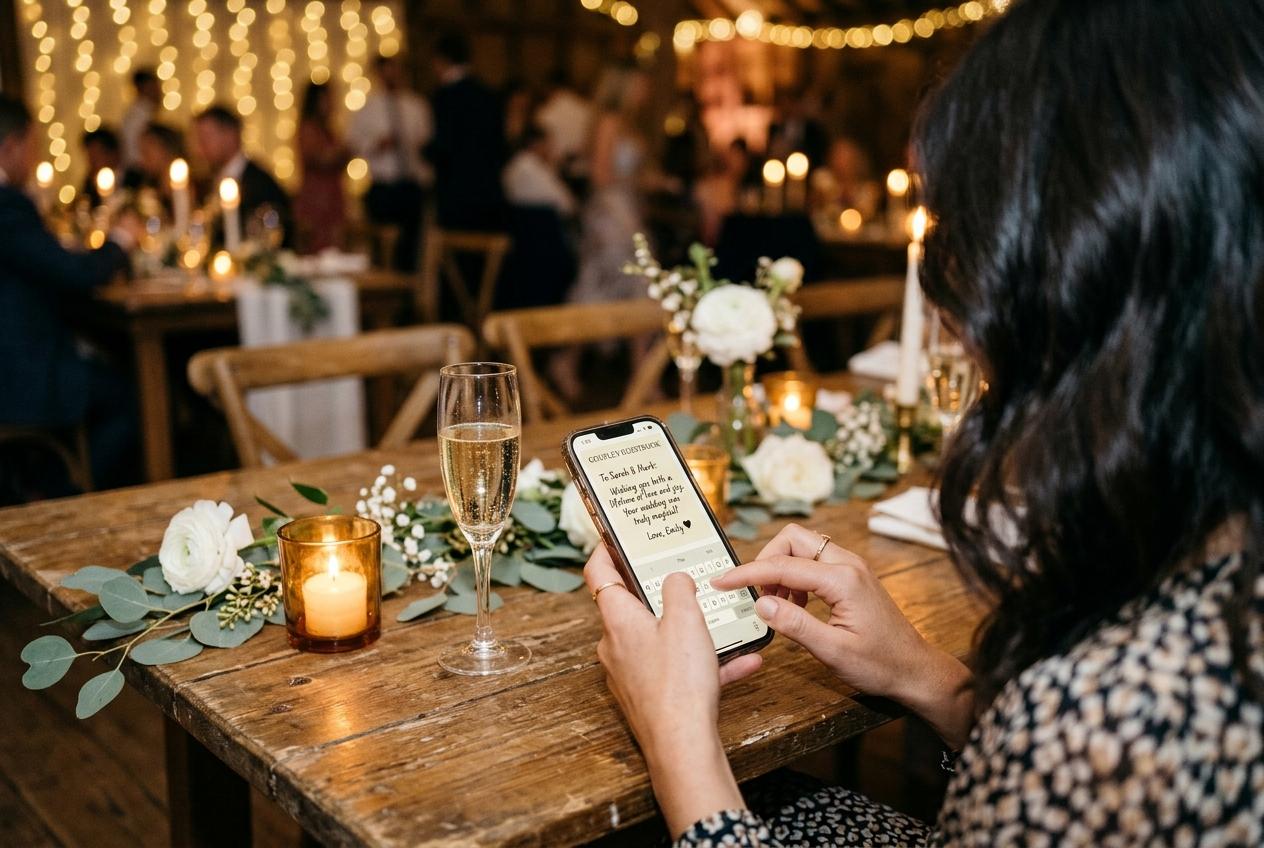
Build a wish from an observation and a hope
You do not need an elegant quotation to write a meaningful guestbook entry. Start with something true: a quality you admire, a moment you witnessed or the simple pleasure of being invited. Follow it with a wish for the couple. Add your name, especially if you use a nickname they may not recognise years later. This structure gives the message a reason to belong to these particular people without demanding a detailed history of your relationship.
Choose one honest detail
Perhaps they made a nervous guest feel welcome, found humour in a disrupted plan or brought two groups of friends together. Pick a detail you actually know. If the only thing you know is that the ceremony was moving, that is enough to begin with.
Turn the detail towards the future
If their hospitality impressed you, wish them a home full of good company. If you admire their teamwork, wish them more adventures together. A connected wish feels more personal than adding a grand sentence about eternal happiness to an unrelated anecdote.
Stop before explaining everything
Two to four sentences can hold a complete thought. Length is not a measure of affection. Remove the background that only you need to remember the story, and retain the part the couple will recognise when they read it.
Short messages for a small space or a quiet mood
A brief message does not have to sound like a greeting-card caption. Address both partners and give the wish one concrete image. This works for a paper book with limited space as well as a digital message written from a phone. If you are uncomfortable with emotional language, use plain words rather than trying to imitate a more sentimental friend. The following samples are alternatives, not a paragraph to combine into one oversized greeting.
- Warm and direct
- 'Wishing you a marriage full of kindness, good company and reasons to laugh. It was lovely to spend this day with you both.' This suits a guest who wants to be affectionate without claiming an intimacy they do not have.
- A wish for everyday life
- 'May the ordinary days be some of your happiest: a shared breakfast, a familiar walk and someone glad to hear your news.' Use this when you want to acknowledge the life after the celebration rather than describe the wedding itself.
- Grateful to be included
- 'Thank you for making room for us in such a joyful day. We hope the years ahead bring you the same warmth you shared with everyone here.' The emphasis stays on the couple, not on how much the guest enjoyed the food or venue.
- Simple without being formal
- 'So happy for you both. Here is to a home where you can be yourselves and a life with plenty of small adventures.' It is perfectly acceptable to sound like yourself rather than adopting a ceremonial voice for the guestbook.
For friends with a history worth mentioning
Long friendships offer abundant material, but the guestbook is not a private reunion conversation. Choose a memory that welcomes both partners into the message. If you know one partner much better, acknowledge the other warmly rather than pretending to share an equally long history. Do not measure the friendship in years as if that establishes priority over everyone else at the wedding.
An old friend welcoming a new chapter
'Elena, our kitchen-table conversations have carried me through so many chapters. It has been lovely getting to know Lukas and seeing the life you are building together. Wishing you both a home full of those long, unhurried conversations.' Replace the names and setting with real details; do not borrow the history.
Friends who know the couple together
'From the first camping trip, you have been the pair who make a soggy weekend feel like an adventure. We hope you keep finding the good in unexpected plans, and we would love to share a few more of them with you.' The message celebrates a shared pattern without retelling an entire holiday.
A friendship that has changed with distance
'We do not get the weekly coffees anymore, but seeing you so happy today felt wonderfully familiar. Wishing you both a marriage with room for old friends, new discoveries and the things that make you feel at home.' Distance becomes context rather than a complaint about reduced attention.
Family wishes that welcome rather than advise
A family entry can be especially meaningful because it recognises continuity and change. Avoid language that treats a partner as being handed over, acquired or finally accepted. Make room for the couple's own choices instead of listing what the family expects next. You can express pride without making the wedding a report on how successfully somebody has fulfilled a parent's hopes.
- From a parent
- 'Watching you make a life together has been a joy. We hope your home gives you both the freedom to grow and the comfort of knowing you are loved. We are cheering for you, today and through all the ordinary days ahead.' This offers continuing support without instructing the couple how to organise their marriage.
- From a sibling
- 'We have shared birthdays, borrowed jumpers and more than a few disagreements about music. I am so happy to share this day too. Wishing you both a marriage full of friendship, patience and laughter that carries through the house.' A harmless childhood detail can add affection without embarrassing either partner.
- From an aunt, uncle or grandparent
- 'It has been a privilege to watch your lives take shape. Today we wish you a future with good health, generous friends and time for each other. We look forward to hearing about the adventures you choose together.' Change any sentiment that does not match your relationship; warmth need not be exaggerated.
When you know only one partner or neither very well
Being a newer acquaintance is not a writing problem to conceal. A courteous wish can be specific about the day without inventing knowledge of the relationship. Address both people by their preferred names and resist phrases such as 'I can already tell you will never argue'. The guestbook does not need predictions or assurances that no outsider can honestly provide.
- For a colleague: 'It was lovely to meet the people who mean so much to you and to share this celebration. Wishing you both a happy marriage and many good things to look forward to.' Leave workplace jokes and internal business details out.
- For a guest attending with a partner: 'Thank you for such a warm welcome today. I loved seeing how much happiness surrounded you both, and I wish you a wonderful start to married life.' There is no need to apologise for not having a long anecdote.
- For a neighbour: 'We have enjoyed the little conversations over the garden fence and were delighted to be here today. Wishing you a home full of laughter and plenty of peaceful mornings together.' Use the actual point of connection rather than a generic claim of closeness.
- For someone meeting the couple at the reception: 'It was a pleasure to celebrate with you this evening. May the warmth of this gathering follow you into the life you build together.' You can thank them for including you without implying you attended the ceremony.
Playful lines that remain kind on a second reading
A funny guestbook message should still work when read without the noise, laughter and context of the reception. Aim at the small absurdities of shared life, not at a partner's supposed defects. Jokes about being trapped, obeying a spouse or needing permission to see friends can make a congratulatory message feel less generous than intended. If you are uncertain, put a sincere sentence after the joke so the affection is unmistakable.
- For enthusiastic travellers
- 'Wishing you a lifetime of good adventures, surprisingly decent airport sandwiches and agreement about when to leave for the station. We cannot wait to hear where you go next.' Use this only if travel is something the couple enjoys, not a costly expectation you are placing on them.
- For people who love hosting
- 'May your table always have room for one more friend and your dishwasher always have room for one more plate. Thank you for the warmth you bring to every gathering.' The humour comes from a familiar scene and leads naturally into appreciation.
- For an affectionate everyday joke
- 'Here is to finding the missing keys, sharing the last biscuit and remembering that you are on the same team. We are so happy for you both.' Keep the line light; a guestbook is not the place to insert a real complaint disguised as a joke.
Write gently around absence, grief and private hopes
Weddings can hold joy beside complicated feelings. If somebody important has died, a mention may be welcome, but do not decide on the couple's behalf that every message should centre the loss. Follow what they have chosen to share. A quiet line such as 'Thinking of the people whose love helped bring you here' may fit better than describing a relative's final days or making claims about what that person would have wanted.
Avoid assumptions about children, fertility, religion, health or money. 'May your home be full of love' leaves room for different futures; 'We cannot wait for babies' does not. Religious language can be warm when it reflects a shared belief, but use a secular wish if you do not know the couple's preferences. If you cannot attend, write 'We are sending our love from afar and look forward to celebrating with you another time' rather than turning the entry into a detailed explanation of your absence. For a strained relationship, a short, sincere congratulations is better than using the guestbook to reopen a dispute, ask for reconciliation or signal a grievance to other readers.
Make an example sound like your own voice
Read the draft aloud once. If a phrase sounds unlike anything you would say, replace it. Formal language is not inherently more respectful, and ornate language can obscure an otherwise lovely thought. Check that every personal detail is true and appropriate for the expected audience. A message can be intimate without revealing information that belongs to the couple or another guest.
- Replace invented names and details with the couple's preferred names and a real point of connection. Check spelling rather than relying on autocorrect, especially when one name is unfamiliar.
- Address both partners. If your anecdote concerns only one of them, let the final wish include the other instead of adding an artificial second story to create symmetry.
- Remove comparisons with other weddings, previous partners or siblings. Praise the day on its own terms without suggesting that somebody else got it wrong.
- Cut any line that asks the couple to reassure you, respond immediately or promise a visit. A guestbook contribution is a gift of words, not another task for two busy hosts.
- Sign clearly and agree joint wording with anyone whose name you add. A household message is useful, but it should not claim to speak for someone who has not seen or accepted it.
Give written wishes a clear place to arrive
Hosts using Candid Photos can share the event link or QR code so guests write in the browser without installing an app or creating an account. The written guestbook must be available and enabled before the invitation promises it. Gather includes written messages, standard downloads, 200 photos, 30 videos, 5 GB and one month online for a one-off USD 19 per event. Preview is free with 20 photos, no videos, ten contributors, 500 MB and seven days online; a written guestbook is a separate USD 9 one-off option, and Preview has no downloads.
For larger collections, Celebrate costs USD 39 per event with 750 photos, 100 videos, 20 GB and three months online. It includes written and video guestbooks, a live slideshow and original-quality media downloads. Keepsake costs USD 69 per event with 2,000 photos, 300 videos, 50 GB, six months online and two extra managers. These are finite online periods, not permanent hosting. Set a useful deadline for written contributions and do not assume a media download is an export of guestbook text. If preserving written entries outside the service is important, confirm the available method before choosing your record-keeping workflow. The host can enable approval to review entries before they appear.
Answers to common guestbook writing dilemmas
How long should my message be?
A few honest sentences are enough for most guests. Use a longer entry when there is a meaningful story to tell, not because a short wish seems insufficient. The couple is likely to value a recognisable voice more than a formal essay.
Can I copy one of these wishes?
You can use these original editorial samples as starting points. Replace personal details and remove claims that do not describe your relationship. A small, truthful change makes the result more useful than copying an invented memory word for word.
What if I already wrote a card?
You can leave a shorter guestbook wish or recall a moment from the wedding instead. You do not owe the couple a completely new declaration, and the host should not make duplicate contributions feel compulsory.
Should I mention a gift?
Usually the wish is stronger without a reference to what you bought or spent. If a gift has a personal story, share that privately in its accompanying card rather than putting financial details into a collection other guests may read.
Make room for small, sincere messages
Open the written guestbook, share a simple invitation and offer one example rather than a required script. The most useful prompt leaves space for the guest's own words.
Guestbooks and written messages
Put one link on the tables and let everyone contribute.
Create a collection, print the table stands, and the photographs your guests took are waiting for you the morning after. Guests never install anything and never make an account.