What guests leave
What a guest leaves when nobody is holding a pen
Written, filmed or sent from home three days later: the three kinds of entry an event produces, how each one is made, and where they end up when the room has gone.
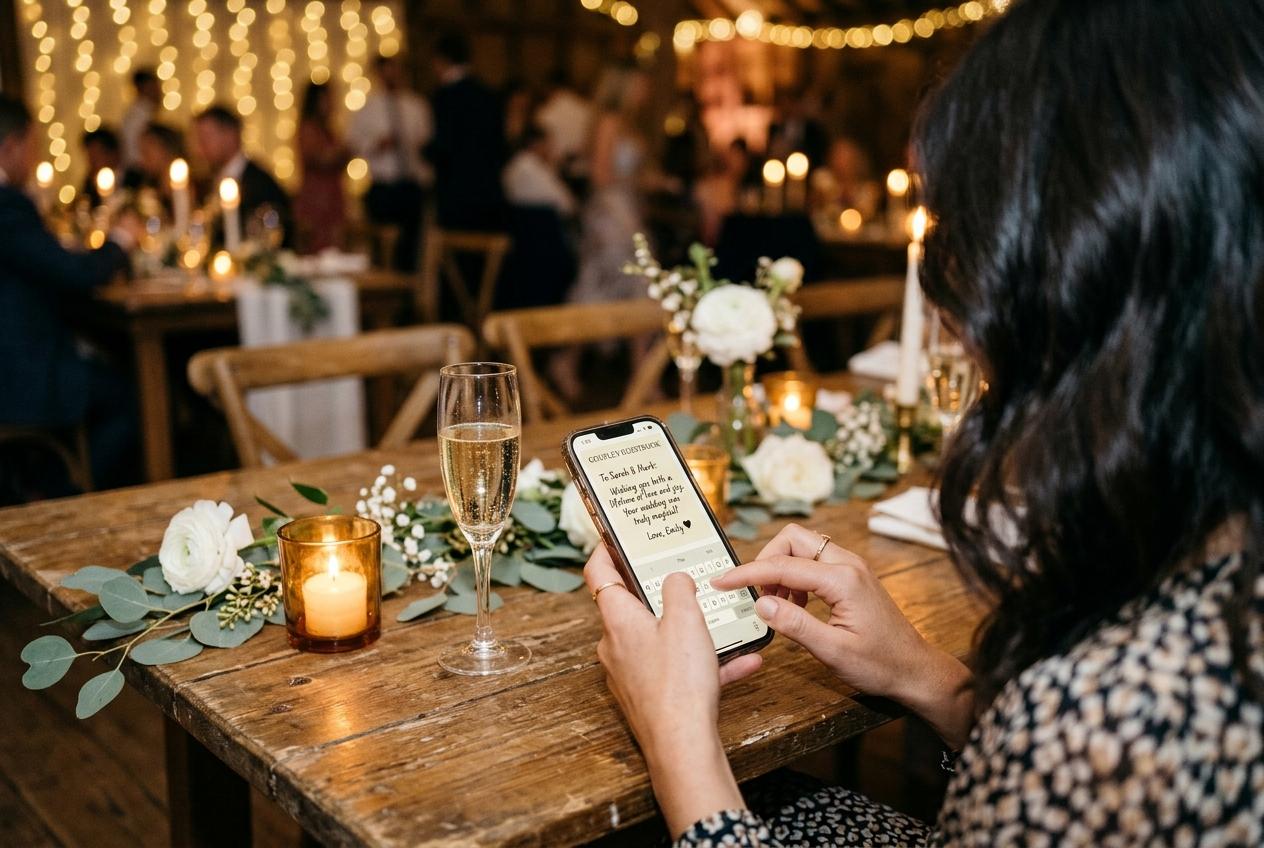
Every event produces more speech than it records. A hundred and forty people say something kind to a couple, a retiree, a graduate or a person turning eighty, and almost none of it survives the evening because there was nowhere for it to go. Guest messages are the part of an occasion that costs nothing to collect and reads better with every year: a written line, a filmed wish, or a note sent from a kitchen three days later. This page is about the mechanism — what an entry is, how it is left, what makes a guest actually leave one, and who can see the result. The photographs are the record of what happened; the messages are the record of what people thought about it, which is the half that is usually missing.
What a message is worth that a photograph is not
It carries an opinion, not a moment
A photograph shows what the room looked like. A message says what the room meant, which is the thing you cannot reconstruct later and the reason the entries from people you have not seen in years are worth reading first.
It names the person who sent it
Every entry carries whoever left it, so the book is searchable by relation rather than by memory. In a family of four grandparents that single field is the difference between a keepsake and a mystery.
It arrives from outside the room
The relatives who were ill, the friend on a night shift, the colleague who left early. A message needs no body in attendance, which makes it the only part of an event the absent can contribute to.
It is the part that gets played twice
Photographs are browsed; recorded messages are replayed. The eight seconds of an uncle losing his thread and starting again is the thing the whole family asks to see again at the next occasion.
The three kinds of entry, and what each asks
- A written message, at the page
- Two taps and a keyboard: the lowest-effort entry and the one almost every guest can manage. It asks for nothing but a name, and it is the format the shy and the older guests use most.
- A filmed message, recorded there
- The browser opens the camera and the guest speaks into the page. It asks for a small performance, which is why it works better with a spoken prompt, a stated length and a friend sitting next to them.
- A clip sent from home
- Somebody films the relative who cannot manage a phone, or records their own wish at a kitchen table two days later, and uploads the file. This is the highest-quality route and the one that reaches the people who were never in the room.
How an entry is left, tap by tap
They open the address you already sent
The same link that takes photographs takes messages, so there is nothing for a guest to choose wrongly and no second card to print. The guestbook is its own switch, separate from the gallery.
They pick writing or recording
Writing is there from the smallest paid plan. Recording needs a plan that carries filmed messages, or the nine dollar one-off addition, so decide which you are offering before the link goes out.
They give a name once
One field, remembered for twelve hours, so the entry left at dinner and the second one sent from a hotel room both arrive with the same attribution and no repeated form.
They send it and see it arrive
A contributor who can watch their own message appear is a contributor who tells the person sitting next to them. That is the whole mechanism of a full book, and it costs nothing to leave the gallery open.
You read it, if you chose to read first
Approval is a switch on the collection settings and it starts off. Turn it on and an entry waits until you accept it — which is what most organisers want when a projector is running or a room full of strangers holds the link.
Prompts that produce something worth keeping
- Ask for advice instead of congratulations: almost nobody knows what to say as a wish, and everybody has one thing they wish they had been told.
- Name a story rather than a sentiment. A memory of the person ten years ago produces paragraphs where a wish produces a sentence.
- Say the length out loud, and make it short. Twenty seconds removes the excuse for not doing it at all.
- Ask the people who are not coming, individually, with a date the book closes.
- For children and teenagers, ask for a wave rather than a message. It costs four seconds and it is the entry the family keeps.
- At work events, ask what the person leaving should do next. It is funnier, warmer and easier than a wish for the future.
- Read the first entry out loud once the book has one. A room that hears what the page is for fills it in the next hour.
A prompt is worth more than an instruction. Every guest can operate the page; almost none of them know what to say when they get there.

When a room will write and when it will not
Before the event
The absent and the early birds
Send the link with the invitation and the relatives who cannot come go first. A book with four entries in it before anybody arrives fills fast; an empty one looks like a form nobody wanted.
The first hour
Too busy and still holding a coat
Almost nobody writes on arrival, and that is fine. The photographs come first because they are easier, and the messages follow once people are seated and have two quiet minutes.
After the main moment
The window that fills the book
Speeches, cake, awards, the toast — whatever the occasion's peak is, the ten minutes after it are when a room is warm, emotional and holding a phone. Say the request again there rather than at the start.
Two to five days later
The tail that surprises you
The best entries arrive late, from people who were too tired at the party and think about it on the Wednesday. This is the part a paper book can never collect, and it is why the closing date matters.
Where entries appear, and who can see them
- On one page, with the photographs
- Messages and images live at the same address so the entry and the frame from the same moment are found together. There is no second link and nothing for a guest to guess wrong.
- To the people you handed the address to
- Guest pages are kept out of search indexes and the link is not published anywhere. The book is as private as the paper you handed out and the messages you forwarded.
- Browsable or closed
- The gallery can be open so everyone reads everyone else's entries, or set to upload-only for a room of strangers, a school, or a workplace where colleagues have not consented to being read.
- Ordered by you, afterwards
- Entries can be featured at the top of the page, which is how a book gets an order: the grandparent first, the friend who made the table laugh second, the message from somebody who could not come last.
- In the download, with names
- Every written and filmed message is inside the archive alongside the photographs, with the contributor attached. The collection has a closing date; the archive you take does not.
Reading the book afterwards
The first reading is always the same: you look for the entries from the people you love most, and you play the filmed ones twice. The second reading, a year later, is the one that surprises you, because the message from the colleague you never met says something true about the person who left, and the eight seconds of a shaky clip explains an evening better than any photograph could.
Do not sort it while you are emotional
Nothing needs deleting on the first pass. Whatever felt like noise at eleven o'clock reads differently in the following week, and an entry that only the two of you ever see is still worth keeping.
Send three entries back to their authors
The relative who recorded from hospital, the friend who made everybody laugh, the grandchild who waved. One line each, with the clip attached, and you will have done the thank-you that nobody else manages.
Put one on the wall at the next occasion
Playing a filmed message at the following birthday is the most persuasive argument for doing this again that exists, and it costs nobody anything.
What a plan has to carry for messages
- Written entries
- Included from the smallest paid plan, at nineteen dollars, with 200 photographs and 30 clips in the same collection and six months online.
- Filmed entries
- Included on the two upper levels, or added to the entry plan as a nine dollar one-off. A page that promises a filmed book and cannot take one is the single worst surprise available at an event.
- Volume
- A message belongs to the book rather than to the photograph collection, so a full page of writing never eats into the picture allowance. Filmed messages are the part to count: a room of sixty willing speakers is sixty clips, and the clip ceiling is the number to check before the invitations go out rather than during the speeches.
- Keeping them
- Retention of six, twelve or twenty-four months, with extensions at nine or fifteen dollars, and a download that includes the messages. Every price is charged once per event and no guest ever sees one.
The photographs tell you what the room looked like. The messages tell you what it meant.
The questions that come before you ask a room to write
Do guests need an app or an account to leave a message?
Neither. The browser on the phone in their hand opens the page, they give a name once and are not asked again for twelve hours, and no price is ever shown to a contributor.
Can a message be left after the event?
Yes, and most of the best ones are. The address keeps working for as long as the collection is online, which is why the closing date belongs in the message you send the following week.
How do you get a room to write anything at all?
One spoken request with a specific ask in it, a prompt on the page that says what to write, and one entry read out loud once the book has any. Those three together are the whole method.
Can we see the entries before other guests do?
Yes. Approval is a switch on the collection settings, off by default, and it holds a submission until you accept it. Anything turned down is left out of the archive as well as the page.
Are the messages private?
They sit at an address that is not listed and are kept out of search indexes. Who sees them is decided by who you gave the link to and whether the gallery is open or upload-only.
Do filmed entries work for older relatives?
Often only with help, which is fine: somebody else films them and uploads the file with their name on it. A written entry typed by a niece arrives in the same book, and both are better than no entry.
Can the messages be played on a screen during the event?
Yes, at the separate slideshow address, which is what turns a quiet page into something the room notices. The screen link is a different address from the collection, so whoever runs the television cannot accidentally open the dashboard.
What happens to the book when the collection closes?
Warning mail arrives first, and after that the archive you downloaded is the only copy left. Take it in the first month, when the occasion is still the most interesting folder on the laptop.
Ask for the message, in words they can answer
Switch the guestbook on, write one prompt worth replying to, and send the link before the event so the people who cannot come go first.
Guestbooks and written messages
Put one link on the tables and let everyone contribute.
Create a collection, print the table stands, and the photographs your guests took are waiting for you the morning after. Guests never install anything and never make an account.