Wedding messages
The wedding messages that never reached the card table
A page takes a wish from the cousin standing at the bar, the grandfather in another country and the friend who will not write two lines in public — the three entries a bound book reliably misses.
Wishes, notes and congratulations that survive the evening.
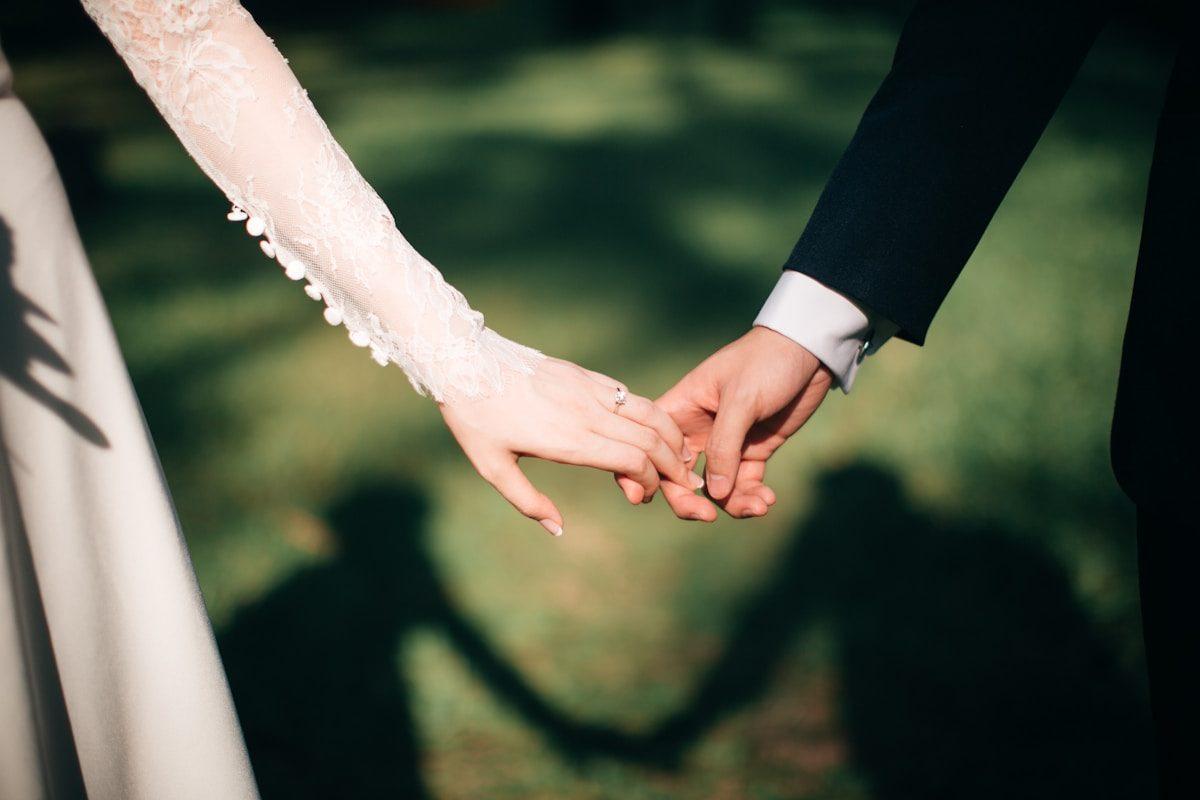
By nine o'clock the card table has one working pen, a queue of four and a couple who have both decided to go back to their seats. The fluent writers have already left you two lines you will read on your tenth anniversary. Everyone else is standing in the doorway thinking about whether they can do it later, and they cannot, because by then the book is in a box at the florist's. A digital wedding guestbook is not a replacement for that object — it is the collection of everything the object could not hold. The same guest, in the same gap between the cake and the dancing, speaks or types into the phone that was already in their hand, and the entry lands in the same book as the ones from the sixty people who were not in the room at all.
What a wedding guestbook is actually for
Holding the words nobody said out loud
A wedding has a great deal of speech in it and very little of it is recorded. The line your father-in-law said to you in the hallway, the advice from the friend who drove four hours — a page catches the ones that never reached a microphone.
Including the people who could not come
The relatives who are ill, the colleagues who were working, the friends on the other side of an ocean. An address needs no body in the room, and a message from somebody who missed the wedding is frequently the one that lands hardest.
Keeping the voice as well as the sentiment
A card tells you that Henrik wished you well. A recording tells you how he said it, the joke he recycled from your own engagement twenty years ago, and the point where he had to stop and begin again.
Being readable in twenty years
Every entry carries the name of whoever left it, so the handwriting that nobody can decipher and the note that says only Love from all of us are both solved by the same field on the form.
The window a room will actually use
A fortnight before
The absent go first
Send the address early and the people who will not be there record from their own kitchens, with time to say the whole thing. Marta and Tobias wrote theirs two days before the wedding, because they were told both the date they were missing and the date the page closes.
Between the cake and the dancing
The only live window
Guests are warm, cheerful and already holding a phone. Say it once during the welcome, keep a stand on every table, and do not count on anybody remembering an instruction given during the speeches.
The following morning
One pass while the room is fresh
You will look through the entries in a hotel bedroom while somebody is still unstacking chairs, and you will notice the cousin who talked for eight seconds because the table was loud. Send them the address again, by name, and they will do it properly in the car.
The week after
The slow and valuable tail
The guests who flew home, the ones who did not want to be filmed at a table, and the friend who promised something and then actually sent it. Late entries land in the same book with the same name attached, and are often the best of the set.
Setting the book up before the invitations are printed
Switch the guestbook on, separately from the gallery
The guestbook is its own switch on the collection settings, so a wedding page can take messages only, photographs only, or both from one link. Decide before anything is printed, because a guest promised a book who arrives at a plain page will not come back to it.
Choose written, filmed, or both
Written messages come with the smallest paid plan. Recorded video is included above that or added as a nine dollar one-off, and the free level carries neither, so it cannot rehearse this part of the evening at all.
Decide whether you read them first
Approval is a switch on the collection settings and it starts off. Turn it on when a hundred and fifty people hold the same link, or when the room includes children, or when the entries are going to be read out at the top table.
Write the prompt the guest sees, not a description of the feature
One line, in your own words, about what you would like to hear. Ask for advice rather than congratulations and the entries get longer on their own.
Print the stands and put the address in the wording
Four cards on an A4 sheet from the dashboard, one line in the invitations, one in the order of service or the programme. Most entries are made at the table rather than at home, so the paper is the distribution.
What to ask for, in words guests will act on
- Advice for the two of you, rather than wishes for the day. Everybody has one thing they wish somebody had told them at twenty-eight.
- A story about one of you separately, before the other. These are the entries the family will read out loud.
- A message to the person whose wedding it is, by name, so it is addressed rather than generic.
- Something from the people who did not come, asked for a week early rather than a week late.
- One sentence from the children, which takes four seconds and is the part you will keep forever.
- A filmed entry from the relative who cannot travel, recorded by whoever is sitting next to them at home.
Say the length as well as the subject. A guest who has been told it can be twenty seconds records twenty seconds; a guest who has been told nothing records nothing.
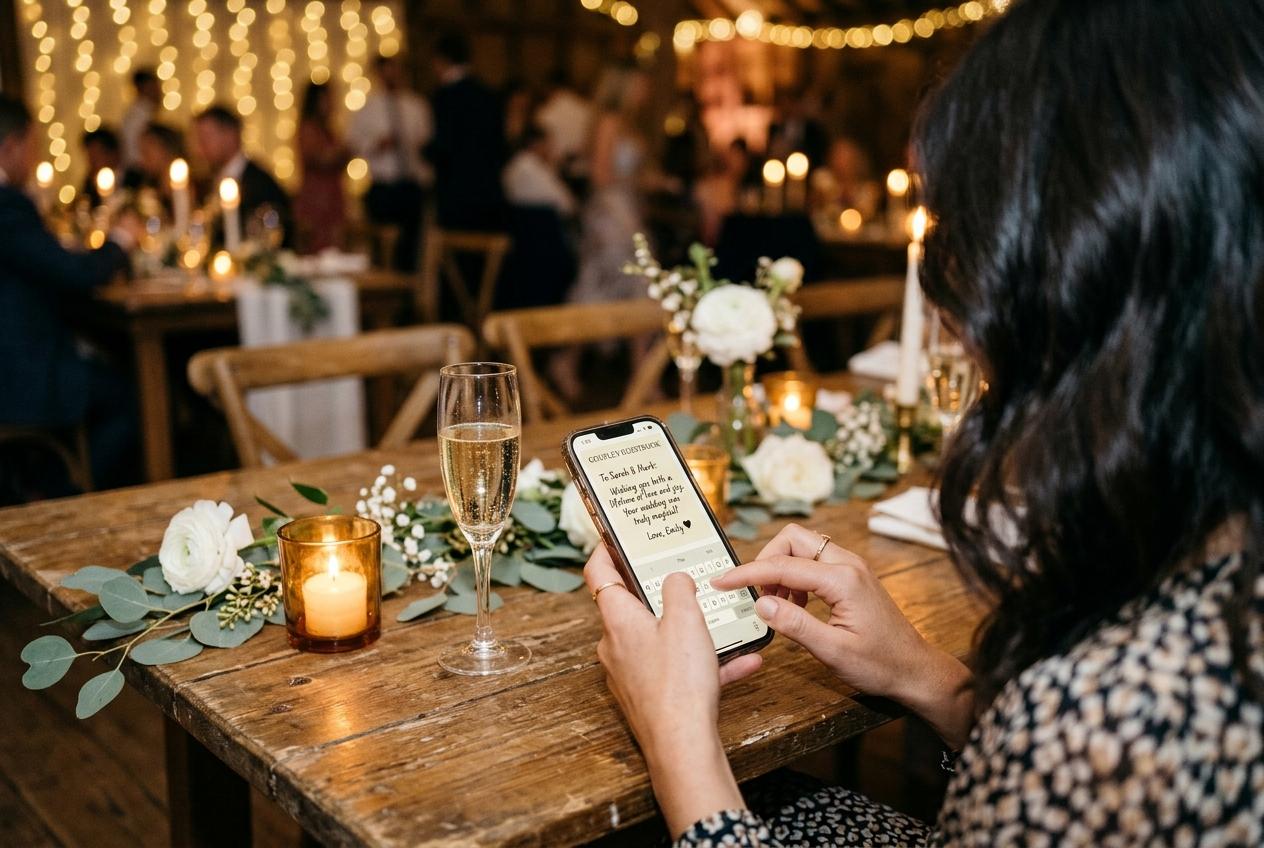
The entries only a page can get
- The one recorded at two in the morning
- The friend who was dancing all evening and only remembered on the way back to the hotel. There is no card table at that hour, and no queue, and they will happily say the whole thing twice.
- The one from a different country
- The aunt who sent a present and a card by post and could not come. A filmed wish from her kitchen is a different object from a written one and it arrives without a stamp.
- The one from the guest who will not write
- Plenty of people cannot compose two lines in front of strangers and will speak forty seconds into a phone. Speaking is a lower bar than writing, which is why filmed entries routinely outnumber written ones at the same wedding.
- The one with the room in the background
- The band, the clinking glasses, a child asking to be carried. An entry recorded at the reception keeps the evening that surrounded the speaker, which no card has ever managed to hold.
- The one you can find again
- Entries carry names, so you go straight to your uncle's speech rather than turning forty pages of handwriting looking for the one that made the table laugh.
Reading it back, and choosing what comes first
The book fills and then it needs a shape, or it becomes a list of files nobody opens. Two levers do all the work: featuring, which puts the entries you want at the top of the page where the family will look first, and the review switch, which decides whether an entry appears before you have read it. Everything else about the experience is set on the evening and never touched again.
- Feature the three you want people to see
- The grandparent, the friend who made the table laugh, the message from somebody who could not come. Featuring is a decision you make after the fact, and it is the part that turns a page of entries into a book with an order.
- Keep the rest below, unreadable is not the answer
- Nothing needs deleting because nothing is published anywhere. An entry that only you two will ever see is still an entry, and half the good ones look terrible as a first impression and wonderful in the second hour.
- Take the download in the first month
- Every written entry, with its author named on it, in the book at the collection address, and every photograph and clip in one archive. The collection has a closing date counted from the wedding; the copy on your own drive does not, so the entries are copied out of the page before that date rather than chased after it.
Two books, one evening
Keep the pen for
- The shy guest who will speak to no lens and write two lines when nobody is watching.
- The handwriting itself, which is the thing people miss about the past.
- The relatives who do not trust a screen and should not have to.
- An object your grandchildren can hold, close, and read the inside cover of.
- A record with no plan behind it and no date when it comes down.
Open the page for
- The sixty names on your invitation list who are not in the room.
- Voices, faces, and the noise of the evening behind them.
- The guests who will not write in public but will happily talk.
- Entries with names on them that you can find again in a second.
- A single book the family can all open, in two countries, in the same week.
Running both costs one extra switch and one sentence in the welcome. Most couples who think about this afterwards wish they had, and almost nobody wishes they had not.
What each plan carries
- The free level
- Twenty photographs, ten contributing guests, seven days online, no downloads — and no messages of either kind. Useful for testing the printed stand and the wording, and nothing else about a real wedding.
- Gather, nineteen dollars
- The written guestbook starts here: 200 photographs, 30 clips, unlimited contributing guests, six months online and standard downloads.
- Celebrate, thirty-nine dollars
- Written and filmed messages both included, 750 photographs, 100 clips, original-quality downloads and twelve months online. The choice when the voices are the point rather than a nice extra.
- Keepsake, sixty-nine dollars
- Everything above with 2,000 photographs, 300 clips, two years online, premium gallery themes and two additional people who can help manage the collection.
- Extras, priced once per event
- A recorded video guestbook can be added to Gather for nine dollars, additional upload allowance costs five to fifteen, and longer retention nine or fifteen. No guest ever sees a price.
The card table keeps the confident. A page keeps the room, the absent and the ones who were never going to write.
Questions couples ask before switching the pen for a page
Do my guests need an app or an account to sign?
Neither. The browser on the phone they already own opens the page, they give their name once and are not asked again for twelve hours. Nothing to install and no price shown at any level.
Can people write instead of appearing on camera?
Yes, and both live on the same page. Written entries are there from the smallest paid plan, so the neighbour's two lines sit beside your brother's three-minute speech in one book rather than in two places nobody opens.
Will an older relative manage it?
Some will and some will not, which is why the pen stays on the table. Somebody else can record them at home and upload that file from their own phone, and the entry still carries the relative's name.
Can we read the messages before anybody else does?
Yes. Approval is a switch on the collection settings and it starts off. With it on, a submission waits until you accept it, and anything you turn down is left out of the archive as well as the page.
How many entries should a wedding produce?
Far more written ones than you expect from a room that was told what you wanted, and very few from one that was not. The video allowance on the plan is the ceiling on filmed entries, so check that number as well as the photographs.
Is the book private?
It is at an address that is not listed anywhere, and guest pages are kept out of search indexes. Only the people you handed the link to can open it, which is closer to a closed guest album than to a public post.
What happens to the entries when the collection closes?
Warning mail reaches you first, and after it comes down the archive you downloaded is the only copy that exists. This is the one place paper genuinely has the advantage, and it is the reason the download is a first-month job.
Should the guestbook be mentioned in the invitations?
One line, not a paragraph. A link that opens a page and asks for sixty seconds gets read; an essay about how it works does not. Print the stands as well, because most entries are made at the table.
Ask for the message rather than the handwriting
Switch the guestbook on, put a stand on every table, and let the room fill the book while everybody is still cheerful. Setup takes a couple of minutes, before the invitations are printed.
Guestbooks and written messages
Put one link on the tables and let everyone contribute.
Create a collection, print the table stands, and the photographs your guests took are waiting for you the morning after. Guests never install anything and never make an account.