A fair comparison
Digital or paper: which guestbook a guest signs by morning
A book on a table and a page on a phone are not the same object doing the same job. Here is what each is genuinely good at, which guests each one leaves out, and what survives the removal van.
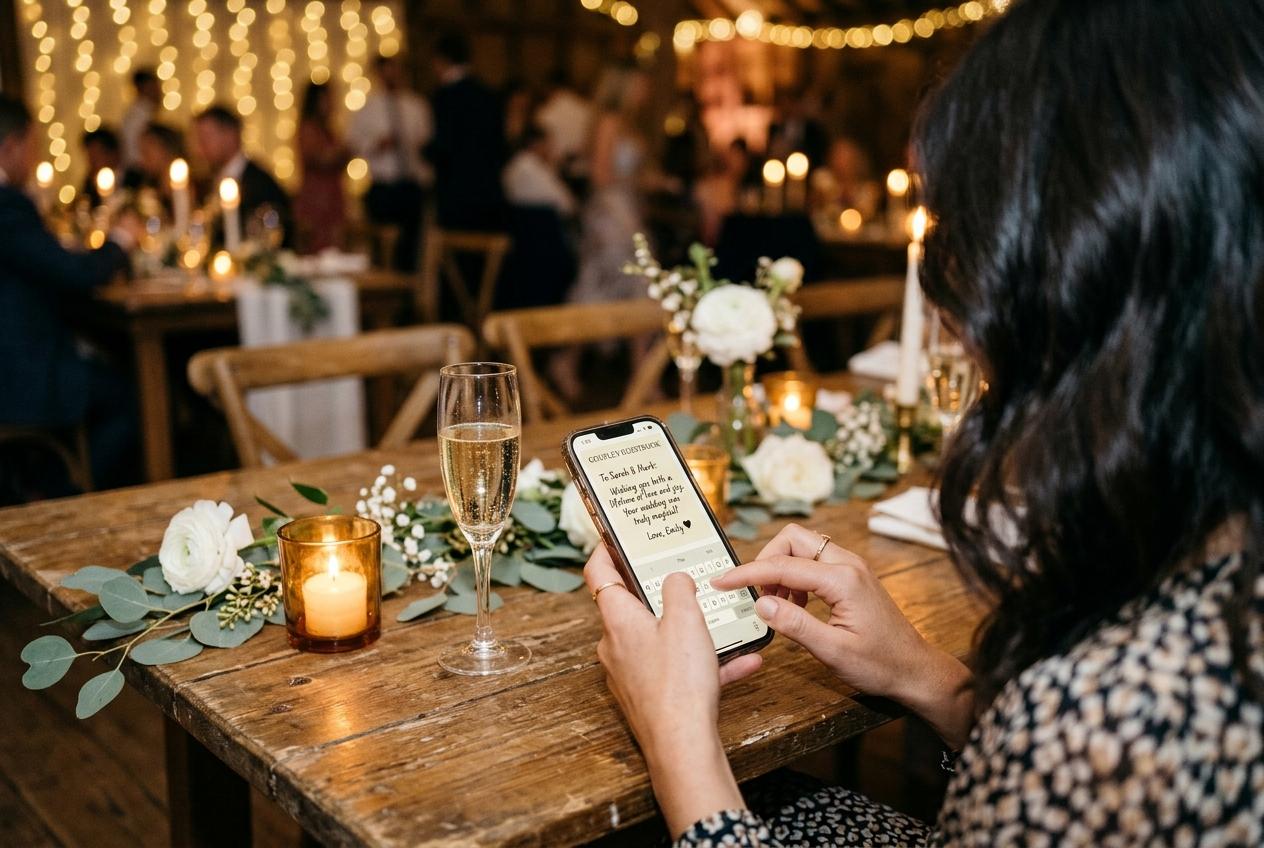
The argument for a paper guestbook is not that it collects more messages. It collects fewer, and it collects them from a narrower slice of the room: the people who were there, who are comfortable writing in front of others, who had forty minutes between the cake and the dancing, and who did not have a queue behind them. The argument against it is equally concrete — a bound book needs a body in the room, which is why your cousins in Lisbon are not in it. A page inverts both. It takes an entry from a person at two in the morning in a hotel bedroom, and it takes one from a grandfather in another country who has been telling people for a decade that he has nothing useful to write. What follows is not a case for one over the other. Plenty of weddings run both, and the right answer depends on whether you want the object, the entries, or the people who would never sign an object.
Two objects doing two different jobs
The book on the table
- A physical thing your grandchildren can hold and close.
- Needs no permission, no battery, no signal and nobody's explanation.
- Collects handwriting, which is the part people miss most about the past.
- Holds only whoever walked past it between eight and nine o'clock.
- Sits on a shelf for forty years without anybody paying a bill.
- Asks for a small public performance in front of a queue.
The page on a phone
- Collects from anybody holding the address, in any country, at any hour.
- Carries a voice and a face, which is a different kind of keepsake entirely.
- Names every entry, so you can find your uncle's speech without leafing.
- Lives at an address, on a plan, with a date when it comes down.
- Can be filled from a kitchen in three minutes by a person who hates forms.
- Requires one explanation, once, and a room that has been told it exists.
The book is a record of the people who were there. The page is a record of the people you invited. Those are not the same list, and the difference is usually thirty names long.
What the paper book is better at
It asks nothing technical
A pen and a page need no signal, no scan, no browser and no battery. Whoever arrives at half past nine sober and tired can still sign, which no phone-based method has ever managed quite as gracefully.
It is an object with weight
Somebody will pick it up at your kitchen table in six years and read three entries out loud. A collection at an address is opened deliberately; a book is opened by accident, which is how most of it gets read.
It suits the fluent writer
Some people write beautifully, fast, in public, with an audience. They leave two lines you will still be reading on your tenth anniversary, and they are a real reason to keep the pen on the table.
Nobody has to be taught it
Everyone in the room already knows what a guestbook is. That is a genuine advantage over anything new, and it is worth stating honestly before deciding the paper version has had its day.
It has no closing date
There is no plan behind it, no mail warning you that entries are coming down, and no download to remember. Whatever is written in it is there until the house burns down, which is the strongest single argument on this page.
What a page adds that a book cannot hold
- The voice, and the pause
- A card tells you that Henrik wished you well. A recording tells you how he said it, the joke he recycled from your own wedding twenty years ago, and the point where he had to stop and begin again.
- The face as it is now
- The photograph on your wall shows your aunt at thirty. A filmed message shows her at sixty-eight, in the dress she wore to the wedding, holding the phone at arm's length because she cannot see the small preview.
- The people who could not travel
- A signed card needs a body in the room. A recorded or written entry can come from a kitchen in Lisbon, from a relative who is ill, or from a friend on the other side of a night shift, and it lands in the same book as everybody else's.
- The guests who will not write
- Plenty of people cannot compose two lines in front of strangers and will happily say forty seconds into a phone. Speaking is a lower bar than writing, which is why filmed entries routinely outnumber written ones at the same event.
- The room around the message
- Background is content: the band, the clinking glasses, a child asking to be carried. An entry recorded at the reception keeps the evening that surrounded the speaker, which no card has ever managed to hold.
- Finding one entry among forty
- Every entry carries the name of whoever left it, so you go straight to the cousin who spoke at the rehearsal rather than turning pages looking for handwriting you half-recognise.
- The things nobody would commit to ink
- Advice from a father, an apology that is twenty years late, a joke that only lands aloud. People say things into a camera they would never write in a book, partly because speaking feels temporary.
Which guest each method misses
The book misses the absent
The relatives who could not come, the colleagues who left early, the friend who was working. These are frequently the people with the most to say, and they are simply not in the room when the pen is passed.
The book misses the shy
Somebody who will not write in front of a queue will also not record into a camera, but they will very often type two lines at midnight in a hotel bedroom, alone, and delete them once before sending.
The page misses the untethered
The guest who cannot work a phone, whose eyes are not what they were, or who does not trust a screen. Let somebody else do the recording and upload it with their name on it; that is the answer, and the book is the fallback.
Both miss the person who was never told
The commonest reason an entry does not exist is that nobody explained there was one to make. A card on a table gets six signatures; a sentence from whoever holds the microphone gets forty contributions of some kind.
Running both, and what it costs you
The honest answer for most weddings is both, and the honest cost is attention rather than money. The paper book needs somebody watching it, a pen that works and a place to sit it that is not next to the champagne. The page needs a stand on the table, a sentence in the welcome and one message the following week. What you are really choosing is whether you want the handwriting kept as an object and the rest of the room's messages kept as files.
- The job the book does on its own
- It gives the shy guest a quiet exit and the confident one a stage, and it produces the physical thing you will both be embarrassed to have paid for and unable to throw out. That is a real function and no collection replaces it.
- The job the page does on its own
- It gathers the names that are not in the room and the entries nobody would write standing up. It also gathers the photographs and the clips into the same address, which a book cannot do at all.
- What one extra page costs
- Written messages come with the smallest paid plan, and recorded video is either included or a nine dollar one-off depending on which you choose. Prices are charged once per event and no guest ever sees one. A bound book costs more than that and lasts longer in the loft.
What survives twenty years
- The book
- Everything written in it, on a shelf, in the form it was left in, with no dependency on a company, a plan or a password. It also survives a house move badly, gets damp, and is the first thing to go in a divorce or a downsizing.
- The collection
- Survives to the length of the period you paid for — six months, twelve or twenty-four, with paid extensions — and warning mail before it comes down. What you downloaded before then is the copy that lasts forever.
- The download
- The only version of this that is genuinely permanent: every photograph and clip as a file you hold on a drive you actually back up, with the written entries copied out of the book while the page is still open. Take it in the first month and the medium stops mattering.
- The honest comparison
- A book outlives a plan without anyone trying. A collection outlives a book only if somebody takes the download, which is a two-minute job that most couples put off until the week they are not thinking about it.
Choose the paper for the handwriting. Choose the page for the thirty names that were not in the room.
Four questions that settle it
- Are there people you invited who will not be in the room? If yes, you need a page as well as a book.
- Do you want to hear voices, or only to read words? A recording is a different object and it is not a substitute for handwriting.
- Will you take the download in the first month? If you know you will not, the book is the safer keepsake.
- Is there somebody in your family who will not touch a phone? Keep the pen. It costs you nothing and it holds their entry.
- Do you have a physical place for a bound book? If the answer is a cupboard, the object argument stops being true for you.
Two yes answers on the page side and you should run both. Almost nobody regrets the extra ninety seconds of setting up a link, and a fair number regret never asking the cousin in Lisbon.
Questions from couples deciding this late
Is a digital guestbook the same as a photo collection?
It is the same address, and the guestbook is its own switch. A collection can take messages only, photographs only, or both from one link, so guests are not choosing between two things they cannot tell apart.
Can guests write as well as record?
Yes, on the plans that carry a guestbook at all. Written entries are there from the smallest paid plan, and recorded video messages are included on the two above it or added as a nine dollar extra on the one beneath.
Will my older relatives manage it?
Some will and some will not, which is why the book stays on the table. Somebody else can record them at home and upload that file from their own phone, and the entry still carries the relative's name.
Can I stop an entry showing before I have read it?
Yes. Approval is a switch on the collection settings and it starts off. Turn it on and submissions wait until you accept them, and anything you turn down stays out of the archive as well as the page.
Do my guests need an app or an account?
Neither. The browser on the phone they already own opens the page, they give a name once and are not asked again for twelve hours. No price is shown to a contributor at any level.
What happens to the entries when the collection closes?
Warning mail reaches you first, and after it comes down the download you took is the only copy that exists. This is the one place where paper genuinely has the advantage, and it is worth taking the archive early.
Is this private?
Guest pages are kept out of search indexes and the address is not listed anywhere, so only the people you handed the link to can open the book. That is a closer resemblance to a closed guest album than to a public post.
Should we mention it in the invitations?
One line, not a paragraph. A link that opens a page and asks for sixty seconds gets read; an essay about how it works does not. Print the stands as well, because most entries are made at the table rather than at home.
Keep the pen, add the page
Set the guestbook switch on, put a stand on every table, and let the room choose its own medium. The free plan runs a real event so you can watch how it fills.
Guides and comparisons
Put one link on the tables and let everyone contribute.
Create a collection, print the table stands, and the photographs your guests took are waiting for you the morning after. Guests never install anything and never make an account.