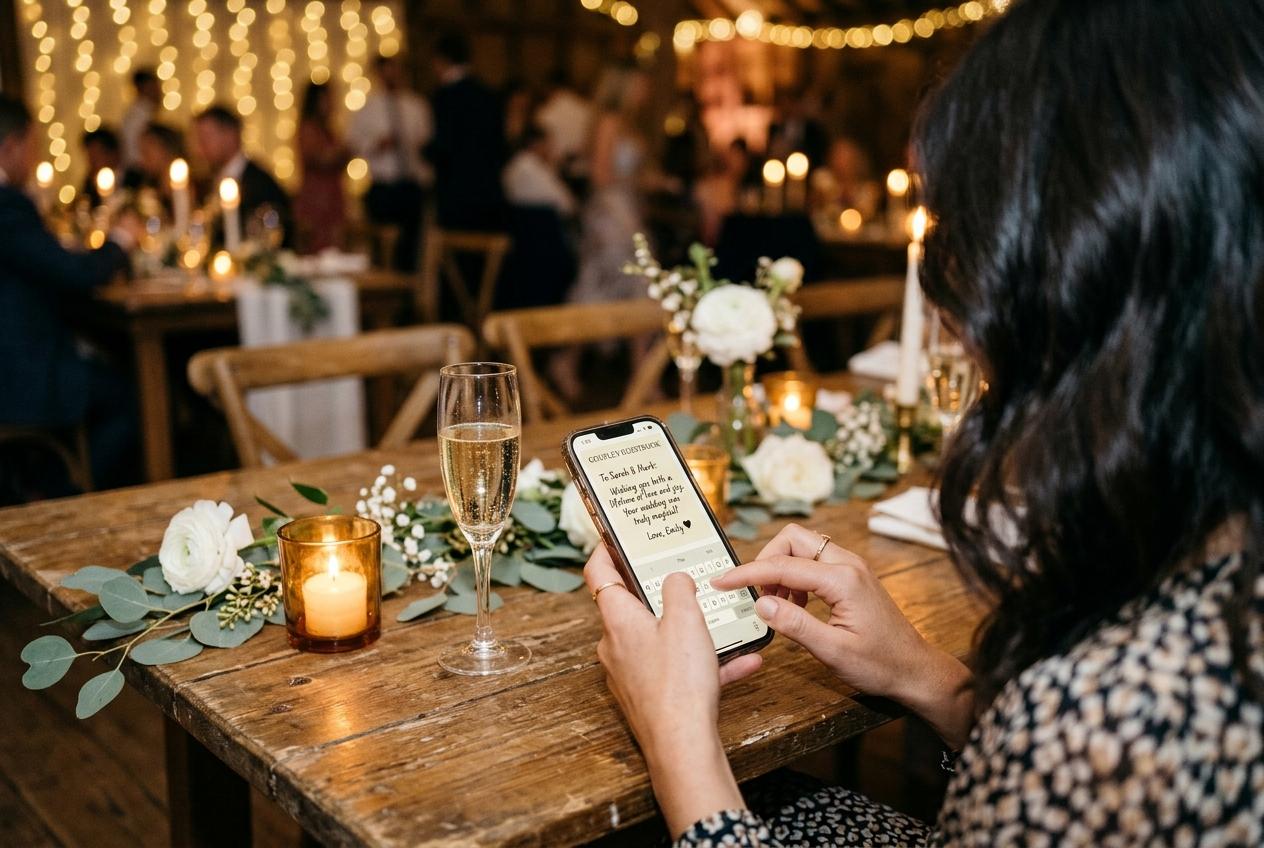
Filmed at home, weeks before
Video messages for weddings, from the people who could not be there
The grandfather who cannot travel, the friend on a work visa, the colleague who will be eight hours away. A message they film in their own kitchen and send in advance is the version of a wedding speech that never needed a microphone.
The message that arrives before the wedding rather than during it
Most of what a wedding misses is not in the room. It is the aunt who could not get the fare, the university friend whose own wedding was the same weekend, the work colleague who was invited out of politeness and is not going to come.
Those people are the ones most likely to send a message and least likely to be asked for one. A card arrives, warm and unread twice; a group chat offers a paragraph that the couple read on a train and never see again. And the thing that would have landed properly, a person talking for forty seconds about the first time they met the bride, is exactly the thing nobody thinks to request, because asking somebody to be in a wedding video feels like a larger imposition than asking them to sign a card.
It is not, in practice. A filmed message is a smaller ask than a card: it takes a minute, it needs no stationery, it can be recorded on the sofa in a hoodie, and it can be sent at eleven at night when the guest finally has a quiet house. What makes it work is timing and one clear request. Ask in advance, give a date, tell them how long, and the clips arrive in the collection weeks before anybody books a caterer.
Who films something, and when they film it
- The relative who cannot travel
- Usually the one with the most to say and the least confidence with a phone. They will not open a page at the venue; they will happily film in their front room if a niece talks them through it and uploads the file for them afterwards.
- The friend abroad
- The easiest of the lot. They are used to being the absent one, they will send something as soon as the request lands, and a three-minute clip from a kitchen in another country is the entry people ask about afterwards.
- The work colleagues
- They film as a group, in an office, badly, holding the phone at arm's length with eleven faces and a filing cabinet behind them, and it is one of the best things in the collection. Give them a due date or they will forget they ever agreed to it.
- The children in the family
- Aged four to fourteen, and the ones who will do it twice because it is fun. Somebody needs to be told to hold the phone steady and to keep the clip short, or the collection acquires nine minutes of a child describing a dinosaur.
- The couple themselves, separately
- A message each, filmed without the other and sent to the same page before the day, is the trick that costs nothing and produces the thing nobody else can: what they wanted this to be like, recorded before they had seen it.
How to ask, in one message
- What you are asking for, said plainly: a short filmed message rather than a card.
- How long it should be: thirty to sixty seconds, and it is fine if it is longer.
- The date it needs to arrive by, which is the single part that determines whether it arrives.
- The address, in text as well as a link, so it can be opened on a laptop.
- The instruction that the file can be uploaded from their camera roll rather than recorded on the page.
- One line about what happens to the clips, because people perform differently when they know an audience will see it.
Send it as a message to individuals rather than to a group. A request addressed to everybody is a request somebody else will answer first, and the private version is also the one that reaches the relative who is not in any group chat.
One more thing worth putting in the message: permission to be rubbish at it. The most common reason a clip never arrives is that somebody recorded four attempts, disliked their own voice on the first, and gave up. A line saying that the bad ones are welcome, and that unpolished is the point, has saved more messages than any technical instruction.
What to say to somebody who hates being on camera
Give them a subject rather than a task
Talk about the trip in 2014 produces forty seconds of speech. Say something nice produces eight seconds of silence and a smile. A specific memory is the only prompt that reliably fills a clip with content.
Let them read it out to somebody else
A parent filming a message while their spouse holds the phone, over a kitchen table, is what most of the good clips look like. The two-person version is easier than the solo one and the voice does not go strange.
Accept a file from a week ago
Somebody recorded something on the day they heard the news and never sent it. Uploading a file they already have is the same submission as recording a new one, and there is no reason to insist on freshness.
Offer the written alternative and mean it
Written messages sit on the same page as the clips. A guest who genuinely will not be filmed can type the thing instead, and the collection is better for having both rather than for having a rule.
Getting the clips into the room on the day
Decide in advance whether anything gets played
Some couples want the messages private and read later. Some want the room to watch the uncle at the end of the supper. The first is easier and the second is the one people remember, and it has to be a decision rather than a discovery at six in the evening.
Turn on the slideshow and give the room its own address
The slideshow plays what has arrived, photographs and clips together, at a separate gated link from the guest page. Whoever is setting up the screen gets that address, so the person moving the flowers cannot close it or wander into the dashboard.
Set how long each clip holds the screen
A filmed message can be allowed to run to its end or be capped at a fixed number of seconds, and the room version is kinder when long clips are trimmed by the player rather than by whoever has to interrupt the dinner to find the remote.
Choose whether the sound is on
Clips with sound need a room that can hear them, which is a different arrangement from a montage under a speaker. For the message you want people to actually listen to, sound on and the toasts wait; for atmosphere, sound off and the photographs carry it.
Keep the originals, not the performance
The download holds every clip at its original size whatever you chose to play. The room version is one evening of the collection; the archive is what the couple still has in year twelve.

Filming badly, filming well, and why it does not matter
What the guest fears
- The light is wrong and my face is a shadow.
- I will start again six times and never send it.
- My hands are shaking and the frame will swim.
- I have nothing clever enough to say.
- Somebody will judge the sound of my voice.
What the collection gets
- A kitchen ceiling at a slight angle, which every wedding clip has and nobody minds.
- A forty-second message that arrived rather than a perfect one that did not.
- The sound of a dog, a radiator, a child in the next room, which is the period capsule.
- The thing said in a normal voice, twice over, with a pause in the middle.
- A person at the age they are now, which is the only reason to film anything at all.
Say this in the invitation message. The single most effective sentence in a request for filmed wishes is the one that tells people the bad version is wanted.
Where the files live, and what the allowance takes
- Collection of clips
- Video uploaded by guests sits in the same collection as the photographs, with the sender's name attached to both, so the message from an uncle and the picture of his hat arrive in one submission rather than two systems.
- How many clips
- Thirty on the entry package, a hundred at thirty-nine dollars, three hundred at sixty-nine. A wedding collecting messages in advance rarely needs more than fifty, and the ceiling is one extra upload pack away when it does.
- Size and length
- A video upload is capped at 100 MB per file, roughly four minutes of phone video, which covers any message a guest will reasonably film. A clip longer than that is refused, and the trimmed copy from the guest's own phone is what comes through.
- How long it is online
- Six months from the wedding on the entry package, twelve or twenty-four on the packages above, with paid extensions. Clips are the reason to take the download early: they are the largest files and the first thing a storage warning is about.
What to do with the messages afterwards
Send each clip back to the person who filmed it
One line and the file, in the week after. It is the thank-you a card cannot do, and it is the reason the same people agree at the next wedding in the family.
Watch the whole set once, together, deliberately
A collection of filmed messages is easy to leave unopened for a year. Sixty minutes on a Sunday, the laptop, no phone in the room, is the hour that makes the exercise worth having done.
Put the download somewhere other than the laptop
Clips, photographs and messages come down together in one archive. Two copies, in two places, is the difference between a wedding record and a failed hard drive, and it costs nothing but the hour.
Leave the page open for the ones who were late
A message that arrives three weeks after the wedding is still a message, and the collection is still the same address. People who heard about it second are frequently the ones with the best thing to say.
A card is read once and put in a box. A voice is played again on a bad week, which is the only honest argument for asking for one.
Questions about filmed wedding messages
Do the people filming need an app or an account?
No. The address opens a page in their browser, they either record there or upload a file they already have, and they give a name once, which the page remembers for twelve hours.
How far in advance should we ask?
Six to eight weeks gives the relatives time and gets the clips in before the last of the planning. Two weeks works for friends. Anything sent in the week before the wedding is a message to somebody who will forget it.
Can we play the clips in the room?
Where the slideshow is included or added, it plays what has arrived at its own gated address, with photographs and clips mixed and each clip capped at a length you set. Sound is your decision rather than a default.
Are the messages private?
The address is not listed, guest pages are kept out of search indexes, and only people you handed the link to can open the page. Entries can also be held until the host accepts them, which is the option to use if the clips are a surprise for the couple.
What does it cost to collect filmed messages?
Charged once per event, from nineteen dollars, which covers 200 photographs and 30 clips plus the written guestbook. Filmed guestbook messages are included on the two upper packages or added to the entry package for nine dollars.
Can a guest send a voice-only message?
Recording on the page is video. Where somebody cannot be filmed, the written message is the alternative on the same page rather than an audio file.
What if the clip arrives after the collection closes?
It cannot be added, which is why the closing date belongs in your request and why the download is taken in the first month. Extensions of six or twelve months exist for nine and fifteen dollars if the late arrivals matter.
Can we collect the messages before a wedding we have not told anybody about?
Yes, and the switch that holds submissions is what makes it work: nothing appears until the host accepts it, so a page can quietly gather clips through an engagement without the couple having announced anything.
Ask before the invitations go out, not after
A filmed message needs a week of somebody's attention, and the last month of a run-up has none spare. Send the request early with a clear date, and the clips are in the collection while there is still time to change your mind about playing them.
See the plansCollect the absent people into the room
Open a collection, put the address in a personal message to the six people you most wish were coming, and give them a date. The clip takes forty seconds and it is the only version of them being there.
Video and guestbook messages
Put one link on the tables and let everyone contribute.
Create a collection, print the table stands, and the photographs your guests took are waiting for you the morning after. Guests never install anything and never make an account.