
Parties
A party photo slideshow for a room that never sits down
Nobody at a party is seated, on a schedule, or looking at a programme. A wall showing photographs has to work in that room, which means it runs faster, fills up harder, and needs somebody deciding what is safe to play.
A party photo slideshow is the same address and the same twelve looks as a wedding one, dropped into a room with no ceremony, no seating plan and no hour at which anybody stops to watch something. Everything that follows comes from that.
Marta spent the March before her partner's fortieth doing what everybody does, which is assembling a folder of photographs on a laptop and planning to play it after the food. By nine o'clock the room was standing, the laptop was in a bag, and the folder had been watched by four people, all of them relatives. The wall she ended up using that night was showing photographs the guests were sending from the table she was standing at, and she never once had to ask anybody to load something. The difference was not taste or effort. It was that one screen was a presentation with an operator and the other was a collection with an address.
What a party is, as a collection
- It arrives all at once
- A seated event fills steadily between courses. A party fills in three or four sudden clusters, each one set off by a guest noticing the code, and the wall changes visibly in each of them.
- It is vertical, dark and close
- Standing rooms produce photographs of faces too near to the lens, shot upward, in poor light. This is not a fault of your guests. It is what a room with no tables encourages, and it is a reason to prefer layouts that can carry a lot of small frames.
- It repeats without being repetitive
- Twenty angles of one dance floor is a picture of a party rather than twenty copies of one photograph, and the wall is the only place that reads that way. Your own editing happens later, in the download.
- It outlives the room
- The heaviest hour for submissions at a party is not the party. It is the taxi ride and the next morning, when people look through what they shot and send the surprising half of it.
- It includes photographs you did not want
- Late-night rooms produce files that read very differently on a wall than on a phone. This is the honest downside of a party, and it is the reason the decision about looking first has to be made before anybody arrives.
Speed, in a room with no programme
An event with a seated programme
- The room stops twice, so the wall gets looked at deliberately.
- Contributions arrive in a slow line between courses and speeches.
- There is a moment when everybody faces the screen, and a long stretch when nobody does.
- The host can plan around the screen, because the room is planned.
A party
- The room never faces the screen for long, so the wall works as background that rewards a glance.
- Contributions arrive in bursts, and the collection can double in ten minutes.
- Nobody is waiting for anything, which is why the screen keeps running rather than starting.
- The host is inside the room, so the wall has to survive being ignored.
Neither version is better. One is a display people watch, and the other is a thing the room feeds while it carries on around it.
Volume, and what a standing room sends
Plan for the party on files rather than on guests, because the relationship between the two is loose and the heaviest contributor in a standing room is rarely the person you would guess. Forty people in a seated hall with a code on every table produce a couple of hundred photographs spread across an evening. Forty people standing around a bar with a code taped to the bar produce the same count in an hour, with a third of them of the same three friends, and they keep sending after the room empties. The ceilings that matter are the ones on the collection: 200 photographs on the $19 plan, 750 on the $39 one, 2,000 on the $69 one, and extra uploads can be bought for a collection that is still open. A party that runs out of room in the collection is a party that stops filling the wall in the middle of the best hour, which is the one failure a host causes entirely by themselves.
- The room before it filled, taken by whoever arrived first and the person who decorated it.
- Toasts and glasses raised, which every guest photographs at exactly the same moment.
- Group photographs of people who cannot all fit in the frame, sent by the one who could.
- The dance floor, mostly vertical, mostly blurred, and the part of the night the room most wants to see again.
- The tail: the food afterwards, the coats by the door, the last straggler's photograph of an empty room.
Who at the party should be watching the screen
The host, for the first twenty minutes
Open the address, set the tab full-screen, check the wall reads from the back of the room, then stop. A host who is still watching the screen at midnight is a host who has not been at their own party.
The person who owns the music
Not really, and this is the mistake worth naming. Whoever is running the room's sound has their hands and attention fully occupied, and adding your wall to their job is how a screen gets switched off and forgotten.
One guest with no role at all
The right answer. Somebody who came to enjoy the party, who is not hosting, not decorating and not on a speech, agrees in advance to glance at the wall occasionally and tell you if something appears that should not be there. That is the whole job, it lasts fifteen minutes a night, and it is worth more than any setting.
The machine, unattended
Workable if you decided beforehand that the wall may play everything the room sends. It is the arrangement most hosts settle into without meaning to, and it is fine in a room of friends and careless in a room of work colleagues.
Deciding what is safe to play
A party is the occasion where the gap between a private photograph and a public one is widest, because the files arriving at eleven o'clock were taken at eleven o'clock by people who are no longer thinking about who else is in them. There are only two stable arrangements. In the first, submissions wait for a person: you look from your phone as they arrive and what you accept goes up, which turns the wall into something you control with two minutes of attention. In the second, nothing waits and the wall plays whatever the room sends, which is honest, fast, and only sensible among people you would show anything to. What you should not do is choose the second arrangement and then be surprised by it in front of forty guests. Whichever you pick, pick it in the week before, when the room is hypothetical and you are sober.
The wall is the loudest thing in the room after the music
A projector turns an ordinary mistake into an announcement, and it does it in front of everybody at once. If the party contains anyone the guests would not photograph in front of, decide that in advance rather than negotiating it later, and remember that a submission you do not accept is left out of the archive as well as the screen.
How the settings work
Layouts that survive a loud room
- A big count of small dark frames
- Dynamic Mosaic. It turns repetition into texture, which is the only layout that makes thirty photographs of one dance floor look like an evening rather than a fault.
- A party that is really a family occasion
- Polaroid Memories, which reads as a mantelpiece and invites guests to photograph the wall itself. Minimalist Motion is the brighter, harder cousin of the same idea.
- An evening that started in daylight
- Storybook Album carries the early frames well and goes quiet once the room switches to artificial light, so it is the choice for a garden or a marquee rather than a bar.
- A wall nobody was going to look at
- Cinematic Film or Editorial Magazine, one frame at a time, because a small collection of good photographs does not need to be crowded. Both are also the layouts to choose when the room is a leaving drinks rather than a party.
The three hours a party really lasts
Getting going
The room photographs the room
Outfits, the table with the drinks on it, whoever is holding a camera. Seed the collection yourself beforehand, with half a dozen frames of the room empty, because a wall that shows nothing when people walk in reads as an abandoned thing and the first guests are the ones most likely to scan a code.
The busy middle
Clusters, and the moment to look
A toast, a song, a game somebody invented. Each one sets off thirty submissions at once, and the wall changes visibly while the room is still facing each other. This is when the person you asked to keep an eye on the screen earns their fifteen minutes.
Afterwards
The best half arrives when the room is gone
Taxis, kitchens, hotel corridors, and the guest who went through their camera roll the next day. The address keeps playing all of it, which is why leaving the tab open in the corner of a screen the following weekend is worth doing.
What a party wall costs
Nothing extra. The slideshow is not a subscription and not a separate product: it is included with Celebrate at $39 and Keepsake at $69, and it is a one-off add-on of $9 for a single event on Gather at $19. Guests never pay and never see a price, and nobody installs anything to send a photograph. The free plan holds 20 photographs for seven days, and the screen is the same $9 one-off there as it is on Gather. What a paid collection buys a party is headroom, because a standing room sends more files per guest than a seated one. Whether photographs are looked at before the room sees them is a separate switch on the collection, and it is the decision to make this week rather than on the night.
Questions about running a party screen
Does a party need a different setup to a wedding for the same screen?
The mechanics are identical, and the differences are in the room: stands where people stand rather than where they sit, a busier layout for the larger count, and one named person agreed in advance to glance at the wall.
How do I stop the wall showing something the room should not see?
Have submissions wait for you and look from your phone as they arrive, or accept that a live party screen plays whatever the room sends. The first is two minutes of attention, the second is a decision you should make deliberately rather than by default.
Can I get the photographs off the wall afterwards?
The download is the same collection the screen played, so you take one archive and keep it in your own library. Rejected submissions are left out of it, and the plan you chose decides whether files come down at full size.
Will a party fill the collection too fast?
It can. The ceilings are 200 photographs on the entry plan, 750 on the middle one and 2,000 on the top one, and extra uploads can be added to a collection that is still open rather than abandoned when it fills.
Does the slideshow play sound?
Not as part of the display. A wall slideshow is the visual half of a collection, and whatever the room is listening to stays on the room's own equipment, which is what you want at a party anyway, since the screen is competing with forty conversations.
Does anybody at the party have to install something to send a photograph?
No. A code or a link opens a browser page, they choose files, give a name and send. Photographs and clips can travel in one submission, and the page remembers who is typing for twelve hours.
Who should hold the link to the screen?
Whoever is nearest the machine, and ideally that is a venue staff member or the one guest with no other job. The address plays the wall and reaches nothing else, so it is safe to hand over in a way your login is not.
Put the code on the bar, not on the table plan
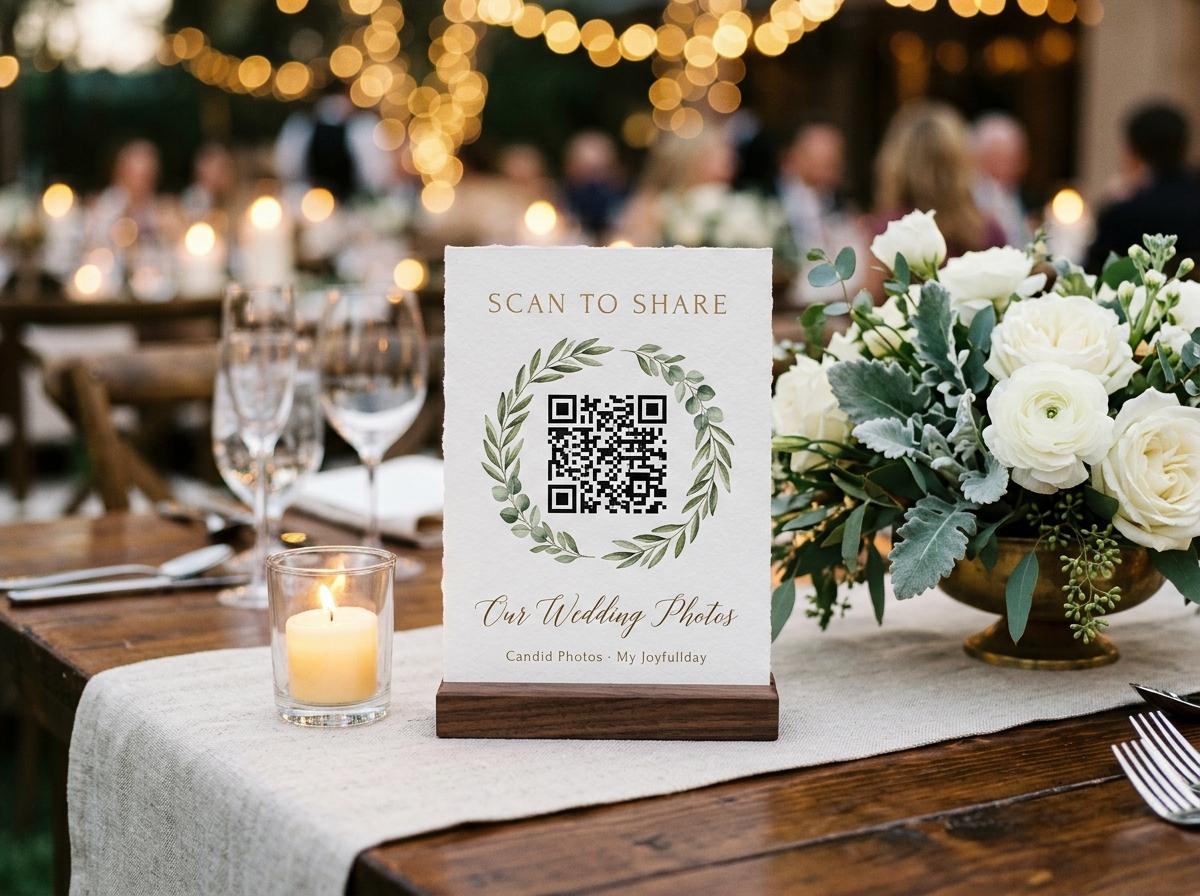
A party wall only works if the standing half of the room can reach it, so print extra stands, tape one somewhere people queue, and decide this week who is going to keep an eye on the screen.
Slideshows and room displays
Put one link on the tables and let everyone contribute.
Create a collection, print the table stands, and the photographs your guests took are waiting for you the morning after. Guests never install anything and never make an account.